Issue 3, April 2015
About the newsletter
Why the Gender Equity Newsletter?
This newsletter aims to connect gender actors and practitioners in Lebanon through the exchange expertise, in an attempt to create a space for better collaboration, networking, and equal access to knowledge, research, and information. Each issue will cover the work of actors, their activities, and projects, in addition to recommending relevant resources and tools, as well as information and statistics relevant to gender work in Lebanon.
The gender equity newsletter is a part of the Gender Collaborative Information and Knowledge Network- a project by Lebanon Support in partnership with Diakonia
The Gender Collaborative Information and Knowledge Network is an online collaborative platform. It is part of Lebanon Support’sCivil Society Knowledge Center (CSKC) and brings together civil society organizations, researchers, practitioners, and experts to enhance local and national capacities, improve access to knowledge and its development, and provide evidence-based research, information, and literature on gender issues and concerns.
1. Featured map on the Gender Equity Information & Research Network
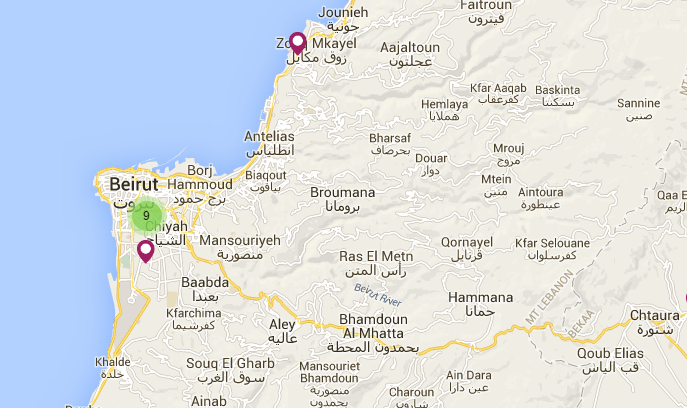
Gender actors map
This map has been developed in an effort to profile, and compile comprehensive information about organisations working on gender issues in Lebanon. Access the Gender actors map and look through it following this link.
Data is based on information provided by organisations and is their sole responsibility. It is still being gathered and consolidated. If you work on gender issues and wish to be listed, please send us an email to contact@lebanon-support.org.
2. Launch of round table series on gender projects and organisations in Lebanon
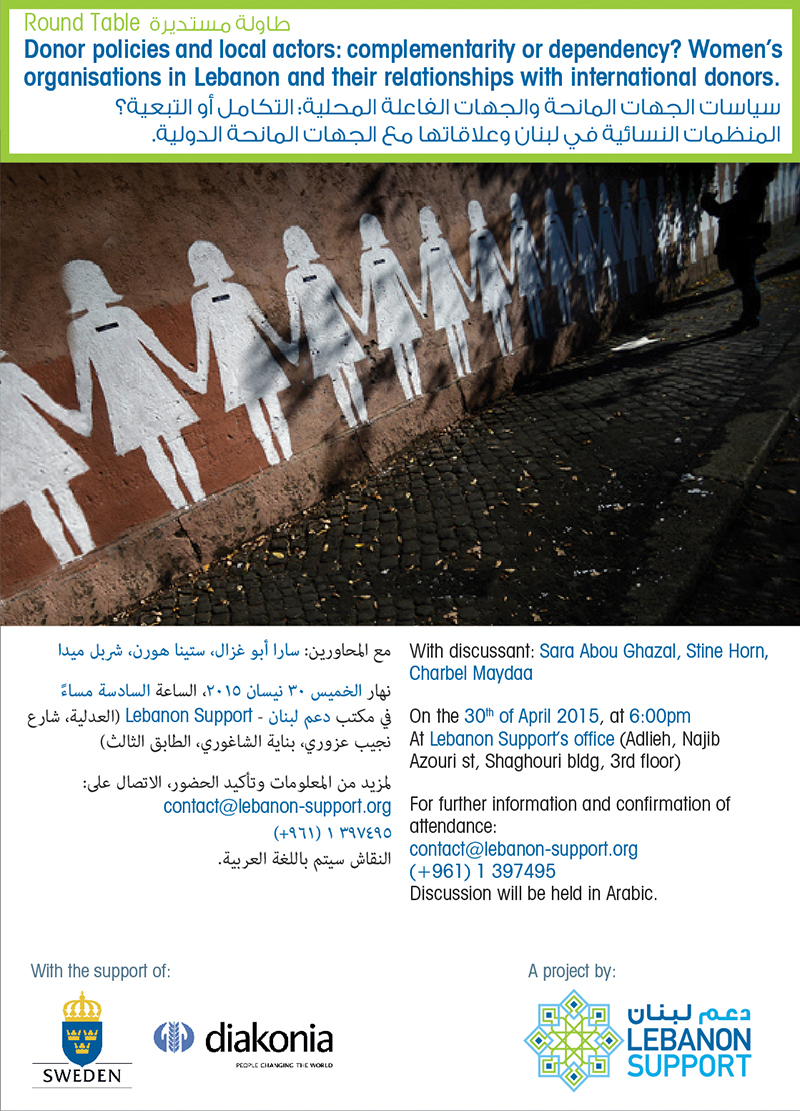
Donor policies and local actors: complementarity or dependency? Women’s organisations in Lebanon and their relationships with international donors.
Presentation by Lebanon Support’s consultant, Dalya Mitri.
With discussants:
Sara Abou Ghazal
is a Palestinian-Lebanese writer who mostly works on feminist knowledge production. She is part of the collective Sawt Al Niswa.
Stine Horn
is the Deputy Head of Mission, Norwegian Embassy in Lebanon.
Charbel Maydaa
is the director of Mosaic organisation.
Women organisations are generally described in the region and in Lebanon in particular as thefrontrunners of emancipatory social change. Their propulsion on the global scene in the vein the Beijing Conference in 1995, has contributed to further the institutionalisation processes they had been going through since the mid 20th century. This trend gave way to the creation of project-oriented, professionalised organisations, structurally relying on international funds.
This round table will discuss the relationships between local women organisations in Lebanon with their international donors; to which extent are these organisations able to develop needs based projects and interventions? Are these projects inevitably informed by transnational and global trends? How are these interventions able to connect/ link local needs and struggles to international agendas? And more generally, it poses the issue of project based interventions versus long term strategies.
This round table is part of a series in the frame of the Gender Equity Information & Research Network project.
The discussion will be held in Arabic.
Date: Thursday, 30th of April 2015, at 6:00pm
Location: Lebanon Support’s office (Adlieh, Najib Azouri st, Shaghouri bldg, 3rd floor - follow this link for the map)
For further information and confirmation of attendance, contact us on: contact@lebanon-support.org
3. FOCUS ON:
Sawt Al Niswa
a. Sawt al Niswa (SAN) is a community of feminist writers, activists and artists from the Middle East based in Lebanon. SAN works on producing feminist knowledge.
b. In 2013, SAN launched a pilot project entitled “Feminism 101” (F101). The collective is aiming to develop further the project for the upcoming summer. F101 gives informal educative courses on feminism influenced and processed by SAN's pool of knowledge. It offers lessons in feminist politics, economy and environment.
c. Challenges:
The sectarian patriarchal system and its values constitute the main challenges of achieving any equality, not only gender equality. SAN believes in nurturing a culture of resistance in which we are able to create livable examples of producing feminist knowledge, and creating relationships and structures that are not embedded in this system.
d. SAN considers that the main demands of women’s organizations in Lebanon should be the following:
1- Gender equality (social, economic and political-- including the right to nationality).
2- Encouraging more grassroots feminist writing and researching.
3- Sexual rights in laws and social attitudes; and the right of people to choose their gender and sexual identities.
4- Protection and inclusion of migrant domestic workers in the labor law.
5- Right to live free of all forms of violence (domestic violence; state violence; sexual harassment etc.).
[link to Daleel Madani profile]
4. Gender news
• From Lebanon
General Security Directorate interrogated human rights’ activists on the basis of campaigning for migrant domestic workers’ rights in Lebanon. The investigations relate to the case of Suzanna Kumar and her mother, Renuka Irangani, being denied of the renewal of their residency. It is worth mentioning that Renuka and her husband were released after a lawsuit was filed by Insan Association.
The Lebanese Center for Human Rights (CLDH) found that 52% of women arrested in Lebanon in 2013 and 2014 were severely tortured by the security forces during investigations. Beatings, deprivation and suspensions - humiliation, threats and insults - violations of privacy by male investigators or guards; these are the main methods of torture and ill-treatment suffered by the majority of women interviewed by CLDH and documented in this report launched on April 16, 2015.
Personal status laws discriminate against women across the religious spectrum and don’t guarantee their basic rights, Human Rights Watch said in a report about women’s rights in Lebanon released in January 2015.
• Around the world
Prominent Lawyer and Woman Human Rights Defender Mrs. Azza Soliman was officially declared defendant after giving her testimony in the killing of activist Mrs. Shaimaa ElSabbagh, who was shot dead by a police officer during a sit-in commemorating the 2011 revolution’s anniversary.
Egypt’s Ministry of Social Solidarity is investigating a non-governmental organization after receiving a complaint that it is involved in promoting safe sex among same sex partners and raising awareness regarding sexually transmitted diseases.
Following the World Social Forum, that took place in Tunis in March 2015,AWID looks back at the Women’s Assembly and discusses some of the issues and challenges of building a feminist movement within the alter-globalization space.
Malta adopted a ground-breaking gender recognition law. TheGender Identity, Gender Expression, and Sex Characteristics Actintroduces, among other measures, the right to determine gender identity based on self-determination instead of undergoing invasive medical procedures.