8، - Issue 8, September 2017
*Scroll down for Arabic
About the bulletin
The Conflict Analysis bulletin, part of the Conflict Analysis Project is an initiative by Lebanon Support, with the support of the United Nations Development Programme (UNDP), available on the Civil Society Knowledge Centre (CSKC), Lebanon Support’s knowledge platform. The Conflict Analysis Project aims to make available and accessible information and research about conflicts in Lebanon, in order to better understand their underlying causes, and inform interventions and policy-making.
This bulletin features visuals focusing on conflict trends mapped during the second third of 2017. It also highlights a selection of the latest publications on the project’s page, including papers, articles, reports, visuals, and interactive content.
Defining Conflict
Going beyond the view of conflict through a security framework associated with belligerency and violence, Lebanon Support upholds that conflict is of a socio-political nature. It thus sheds light on dynamics underlying a broad spectrum of violent and non violent contentions including social movements, conflicts opposing minorities (ethnic, religious or sexual among others) as well as local, national or regional actors’ policies.
Read more on and visit the interactive conflict map here.
Main data trends from the May-August 2017 period:
● The number of incidents mapped in May-August 2017 increased by 22% compared to the first third of the year.
● Arrest/detention and air space violation are the most mapped primary categories of incidents during this period.
● The Israeli Military is the most active state actor on the Lebanese territory.
● The number of incidents involving Syrian civilians/refugees (235 incidents) has significantly increased by 34% compared to the first third of the year, with more than half of the incidents categorised as arrest/detention.
● Armed conflicts with heavy artillery have almost tripled compared to the first third of the year due to clashes in Ain el-Helweh, Arsal, and Ras Baalbeck. (see the third visual below for more information about Ras Baalbeck)
● The incidents relevant to Border Conflicts with Syria have more than tripled during this period compared to the first months of 2017.
● This period witnessed a significant drop by 47% of incidents classified as Policy conflicts compared to the beginning of the year.
1. Overview of conflict incidents mapped (from May to August 2017)
● Locations
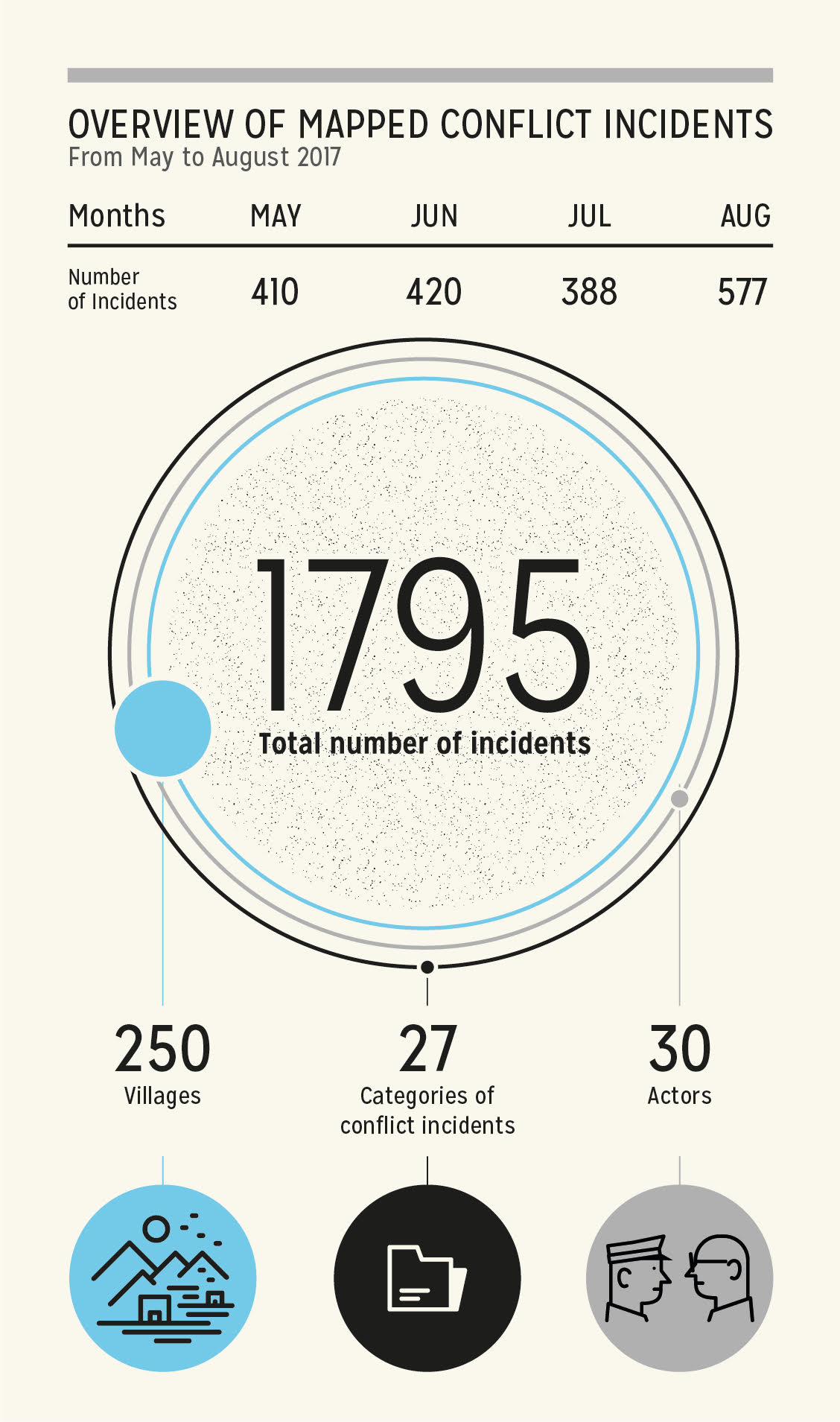
The second third of 2017 witnessed a total of 1,795 incidents, which is an increase of 22% compared to the 1,476 conflicts mapped during the first months of the year.
The conflicts mapped between May and August 2017 appeared to be dispersed across the country with 250 locations recorded during this period. However, 57% of mapped incidents are concentrated in 5 cazas, and represent together a total of 1,022 incidents: Baalbeck (350 incidents), Sour (257 incidents), Saida (173 incidents), Beirut (140 incidents), and Baabda (102 incidents).
In Baalbeck more than half of the conflicts are related to Border Conflict with Syria. Also, 79% of incidents mapped in Sour were classified as Border Conflicts with Israel, with recurrent airspace violation and sea border crossing/violation by the Israeli Military. Moreover, the majority of incidents mapped in Saida are classified as Individual Acts of Violence mostly relevant to arrests, brawl/disputes, shooting, robberies etc. Finally, in Beirut and Baabda 25% of the incidents were classified as Power And Governance conflicts mainly involving illicit trade.
● Categories
The most mapped primary categories between May and August 2017 are arrest/detention (441 incidents), and air space violation (424 incidents). These two categories represent almost half of the total mapped incidents during this period. They are followed by collective action (143 incidents), raids (112 incidents) and heavy artillery (112 incidents). It is also noteworthy to point out that the trend for the top three most mapped primary category incidents is the same as for the first months of 2017.
(Read more about primary and secondary categories here.)
Furthermore, among the incidents categorised as arrests, 144 were assigned the secondary category of illicit trade, with 67% of them related to drugs (67 incidents). Also, 11% of arrests included Lebanese State apparatuses foiling human smuggling operations from Syria. For instance, on July 22nd, the ISF Intelligence Branch arrested in Dahr el-Baidar 55 Syrians smuggled illegally into the country as well as their smugglers. Besides, the number of arrests due to militant funding and support have increased during the second third of 2017 compared to the first months of the year (3 incidents) with 9 incidents related to the smuggling of fuel, food, or money to militants or terrorist groups.
In addition, the number of incidents categorised as heavy artillery have almost tripled between May and August (112 incidents) compared to the beginning of the year (36 incidents). In fact, Lebanon has witnessed during this period three main armed clashes located in Arsal between Hezbollah and Jabhat el-Sham (previously al-Nusra), in Ras Baalbeck between the Lebanese Armed Forces (LAF) and Islamic State (see the third visual below for more information on Ras Baalbeck), as well as in Ain-el Helweh between Palestinian factions.
Finally, the number of gender based violence conflicts reported almost doubled (17 incidents) during this period compared to the beginning of the year (10 incidents). In fact, 6 prostitution rings have been identified and dismantled in only 4 months by Lebanese authorities. For instance, on May 27th, police arrested a prostitution ring as well as their kingpin around Sahel el-Alma area. Also in Zahle, on June 22, four people were arrested on charges of connections with a prostitution ring. However, it is important to point out that gender based violence incidents remain under-reported in Lebanon, especially those relevant to domestic violence or sexual abuse.
● Actors
The main mapped actors can be separated into two groups: state apparatuses and civilians.
The first one includes state security actors such as the Internal Security Forces (ISF), Lebanese Armed Forces (LAF), General Security, State Security, but also foreign state apparatuses such as the Israeli military. In fact, the latter is the most active state actor involved in no less than 531 incidents. It is followed by ISF (357 incidents) and LAF (202 incidents).
The second group includes civilians/refugees such as Lebanese, Syrian, Palestinian, and Turkish citizens among others. Similar to the first months of 2017, Lebanese civilians (524 incidents) remain the most mapped actor in the second group. However, it is interesting to note that the number of incidents involving Syrian civilians/ refugees (235 incidents) has significantly increased by 34% compared to the first third of the year (175 incidents). Also, more than half of the incidents involving Syrian civilians/refugees are categorised as arrest/detention. These figures highlight a general trend in increased policing and securitisation targeting refugee populations in Lebanon, in a context of heightened security threats, and media and political discourse scapegoating refugees.
Besides, 41% of the incidents involving Palestinian civilians/refugees are located in Ain el-Helweh which witnessed an escalation of violence during the month of August, with armed conflicts between Palestinian factions involving gunfire, explosions, and heavy artillery.
Finally, other groups of actors such as political parties as well as armed militants and factions have been involved in different conflicts across Lebanon. For instance, the number of incidents involving the Islamic State has doubled during this period compared to the beginning of the year, with the majority of incidents located in Arsal and Ras Baalbeck outskirts where these groups have been operating.
2. Frequency of incidents by primary classification of conflict (from May to August 2017)
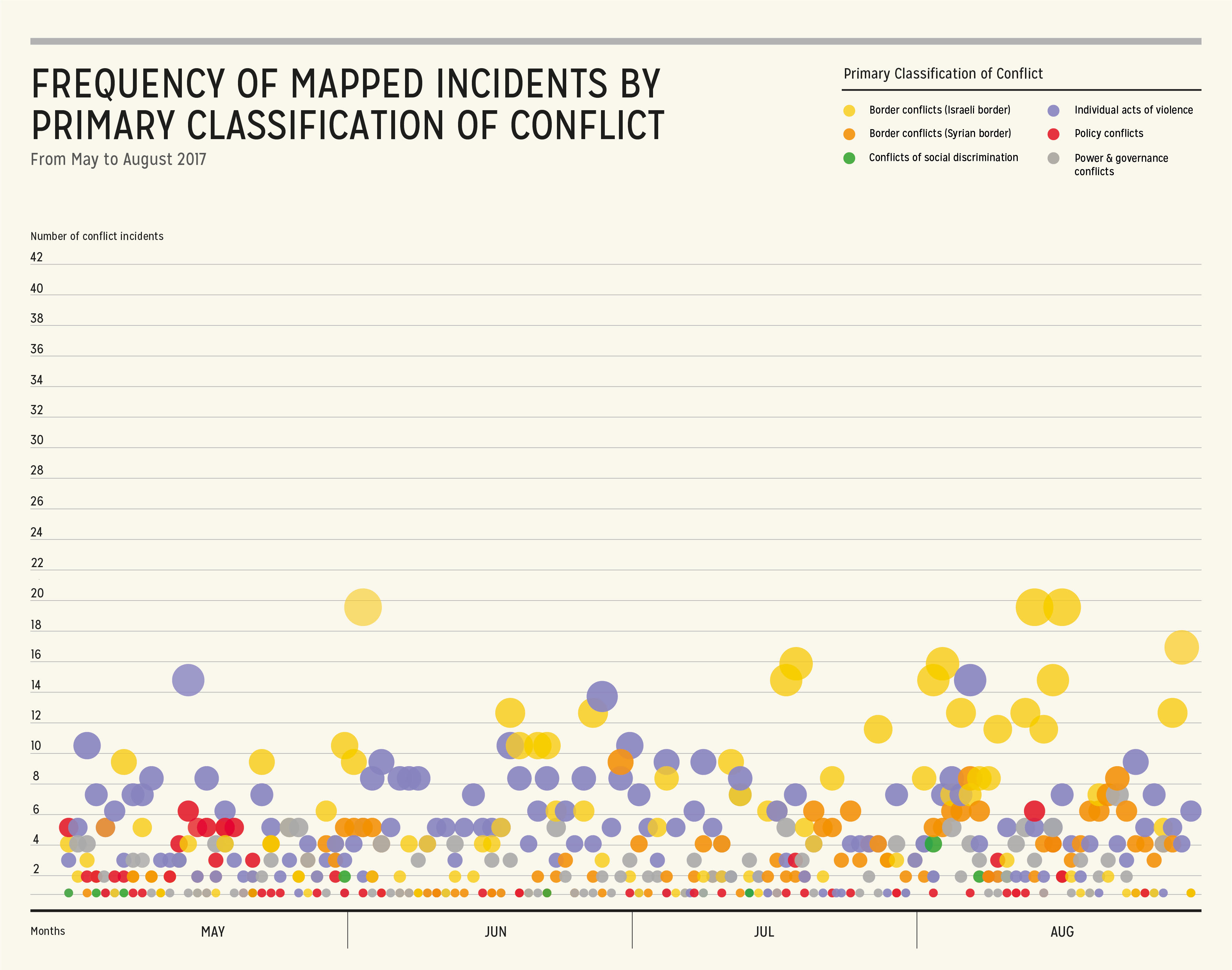
Similar to the beginning of the year, Individual Acts of Violence (588 incidents) and Border Conflicts with Israel (563 incidents) have been the most mapped primary classification during the second third of 2017 .
Focusing on Individual Acts of Violence, 34% of these conflicts are relevant to arrests (202 incidents) and 17% to brawls/disputes (101 incidents), with most of them evolving into shootings (76 incidents). This trend comes in a context where widespread use of weapons has been denounced by civil society groups and activists.
The number of incidents classified as Border Conflict with Syria (286 incidents) has more than tripled between May and August compared to the first third of 2017 (92 incidents). This increase could be explained by several LAF operations conducted against armed militants during this period. One of them took place at the end of June when 5 Jihadi militants blew themselves up during Army raids in Arsal which led to the intensification of LAF operations on Syrian refugees camps. In fact, 50 raids or arrests related to Syrian Border Conflicts were mapped afterwards in July and August. This number is still less than the 63 similar incidents recorded during the same period last year after el-Qaa bombing at the end of June 2016.
The most notable border conflict incident remains the “Fajr el-Jurd” operation during August in Ras Baalbeck outskirts, in which the Lebanese Army led an offensive in order to expel Islamic State militants from Lebanese territories (see the third visual below for more information on Ras Baalbeck). Moreover, a similar operation against Jabhat el-Sham (previously al-Nusra) was conducted by Hezbollah earlier in July in the Arsal outskirts. 82% of Syrian Border Conflicts are also classified as Power and Governance as they involved armed militant groups such as IS and Jabhat el-Sham and threatened the central state’s power and governance.
Also, it is noteworthy to point out that 23 incidents related to Border conflicts with Syria were also classified as Conflicts of Social Discrimination with Army raids on refugee settlements which is consistent with the trends at the beginning of 2017 (22 incidents). However, these incidents are concentrated in three months: May, June, and July.
Furthermore, the second third of 2017 witnessed a significant drop by 47% of incidents classified as Policy conflicts, with only 109 instead of the 207 incidents mapped between January and April. All Policy conflicts mapped in the second third of 2017 were relevant to collective actions. In fact, while the first third of the year witnessed a rise of collective actions relevant to the number of laws, reforms, and decisions issued at the end of 2016, the second third of the year appears to be more steady in terms of political decisions which could explain this drop of Policy conflicts.
While the visual above shows that no Conflicts of Socio-Economic Development were mapped as primary classification, 35 incidents were actually mapped with Socio-Economic Development as secondary classification. These 35 incidents also represent 32% of the total number of Policy conflicts. These incidents are mainly collective actions involving civilians protesting against unpaid wages, unemployment, unfair competition, but also against public decisions such as law reforms concerning rent or tax policies.
3. The Lebanese Army operation against Islamic State
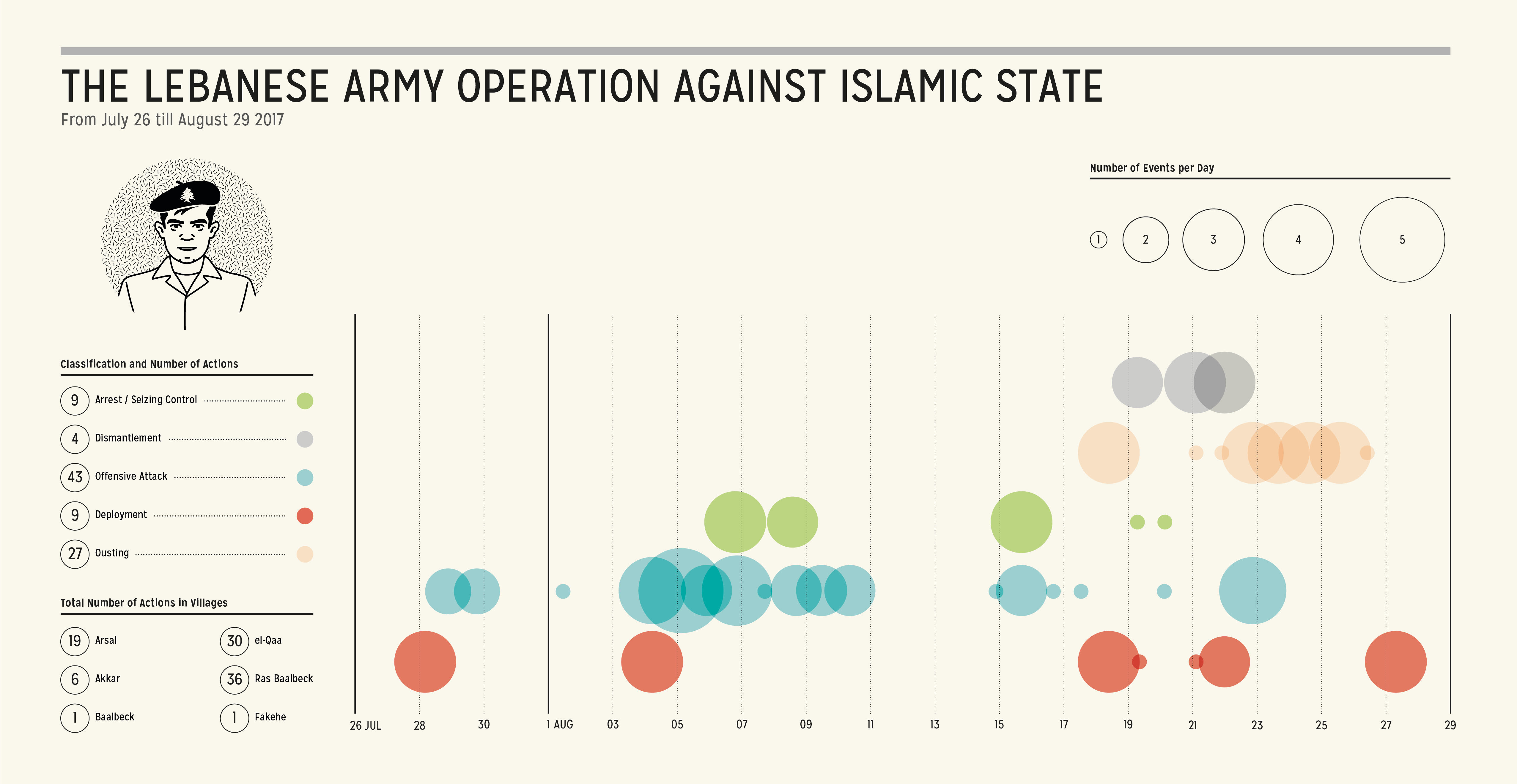
Since 2014 clashes in Arsal between the LAF and transnational militant groups, armed militants belonging to Islamic State (IS) have been operating in Ras Baalbeck outskirts. For over 3 years, the conflict in the border region has evolved and escalated into recurring battles between IS and the alliance of the LAF and Hezbollah, but also between IS and Jabhat el-Sham (previously al-Nusra) which had established its stronghold in Arsal. Although these conflicts have been ongoing since 2014, it is not until July 2017 that offensives against these groups were launched in order to seize back occupied territories.
In fact, at the end of July, while Hezbollah was launching an attack on Jabhat el-Sham militants in Arsal, the Army was preparing an offensive against Daesh positions in Ras Baalbeck and el-Qaa in order to definitely expel them from Lebanese territory, but also to get information about the fate of the 9 remaining soldiers kidnapped by Daesh during the Arsal clashes in 2014 (see Arsal timeline for more about the abducted soldiers’ case). This operation called “Fajr el-Jurd” (dawn of the outskirts) was officially launched on August 19th and lasted for 10 days. However, the LAF seemed to have been intensifying its operations weeks before the actual launch. While the shelling of militants’ posts has been recurrent but occasional since 2014, on July 26th, the Lebanese army started reinforcing its position in the outskirts of Ras Baalbeck and el-Qaa while heavily deploying around the area. The next day, intensive shelling on militants was reported with heavy artillery, airstrikes, and missiles being used. The armed militants responded to these attacks by targeting LAF positions without causing any injuries among its soldiers. On the 3rd of August, after five days of intermittent clashes, the army began a new deployment around Arsal nearby the Ras Baalbeck area. This deployment also came after the withdrawal of Jabhat el-Sham militants from the region, subsequent to Hezbollah’s offensive. On the same day, intensive clashes were renewed in Ras Baalbeck, el-Qaa, and Arsal, and ended five days later with the Army managing to destroy a number of fortifications and vehicles belonging to IS militants while causing numerous casualties among the latter. During these attacks, the Army was also able to seize control over strategic hills that overlooked IS posts, which played a tactical role during the upcoming last battle. Meanwhile, raids took place in refugee camps in Arsal where those suspected of ties with Daesh were arrested. Afterwards, recurrent attacks continued to be launched for days with the Army bombarding militants’ positions and taking back territories occupied by IS.
All these events could be seen as a preparation for the “Fajr el-Jurd” operation that aimed to completely expel IS from Lebanon. From a geopolitical perspective, this battle against IS coincided with parallel attacks led by Hezbollah and the Syrian Army in Qalamoun, on the Syrian side.
On the 19th of August, the ousting of the militants officially began with the Army leading an offensive against their posts in Ras Baalbeck and el-Qaa outskirts, and progressively liberating territories occupied by Daesh. This operation was divided into four stages and lasted for 10 days. The first two stages mainly included the intensive shelling of militant groups with heavy artillery and the seizing of occupied territories. Also, following a landmine explosion left by Daesh that killed three Lebanese soldiers during the first day, army units started scanning the areas planted with landmines and explosive device in order to clear the way for the LAF frontline. As a result, the army managed to foil several Daesh suicide attacks as well as dismantle a number of landmines left by the group. By the end of these two phases, military units were deployed in Akkar and the surrounding areas close to the borders in order to prevent militants from escaping towards other regions while a Daesh security official was arrested by the Intelligence unit. Following these preventive measures, the third stage of the operation was ready to be launched on the 4th day of battle and allowed the seizing of strategic strongholds held by IS as well as large quantities of weapons, munitions, and explosive devices left by the militants. On the sixth day of combat, the Army began to prepare for the final stage of the operation by repositioning its posts in the area. On the 8th day, a Daesh attack on an Army vehicle caused 6 casualties among Lebanese soldiers. Meanwhile, LAF units continued to bombard the remaining militants’ posts until a cease-fire was concluded with the group in exchange of the kidnapped soldiers. Despite the apparent victory of the Lebanese Army against these groups, this battle ended on a bitter note with the announcement of the death of the abducted soldiers who appeared to have been killed years ago by their captors. The remains of their bodies were located close to the Syrian borders and retrieved by Lebanese authorities.
Finally, on the 10th day, the Army completed its deployment in the formerly occupied area and officially ended the operation, while the military’s expert regiments continued to clear these lands from landmines and other explosive devices.
4. Featured mapping within the Conflict Analysis Project
The Conflictivity Index maps for the first half of 2017
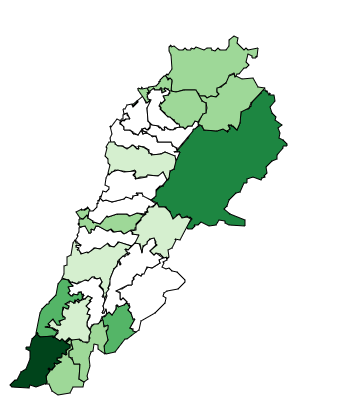
Sour district witnessed the highest intensity of Armed Conflict in the first half of 2017 with a total of 93 incidents. 97% of these incidents are related to Border Conflict with Israel and 96% are categorised as sea border violations from the Israeli Military. Read more
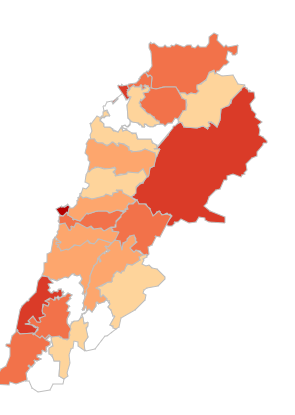
Although incidents in the Collective Action dimension were dispersed all over the country during the first half of 2017, Beirut witnessed the highest intensity in this dimension with 31% of incidents falling in the Collective Action dimension. Additionally, most of the Collective Action incidents mapped in Beirut were classified as Policy conflicts relevant to, among others, Parliamentary elections, rent law, and tax raises. Moreover, in Beirut, 25% of incidents in this dimension were classified as either Conflict of Social Discrimination or Conflict of Socio-economic Development. Read more.
Explore all the Conflictivity Index maps and blurbs for the first half of 2017 here.