
Issue 1, November 2015
About the bulletin
The Conflict Analysis bulletin, part of the Conflict Mapping & Analysis project (CMA) is an initiative by Lebanon Support, with the support of the United Nations Development Programme (UNDP), available on the Civil Society Knowledge Centre (CSKC), Lebanon Support’s knowledge platform. It aims to make available and accessible information and research about conflicts in Lebanon, in order to better understand their underlying causes, and inform interventions and policy-making.
This bulletin highlights a selection of the latest publications on the CMA’s page, including papers, articles, reports, visuals, and interactive content. Additionally, the bulletin includes
visualisations of main conflict trends during the last quarter.
Defining Conflict:Going beyond the view of conflict through a security framework associated with belligerency and violence, Lebanon Support upholds that conflict is of a socio-political nature. It thus sheds light on dynamics underlying a broad spectrum of violent and non violent contentions including social movements, passing by conflicts opposing minorities (ethnic, religious or sexual among others) as well as local, national or regional actors’ policies. Read more and check the interactive conflict map here.
1. Overview of conflict classifications between July 2015 and October 2015
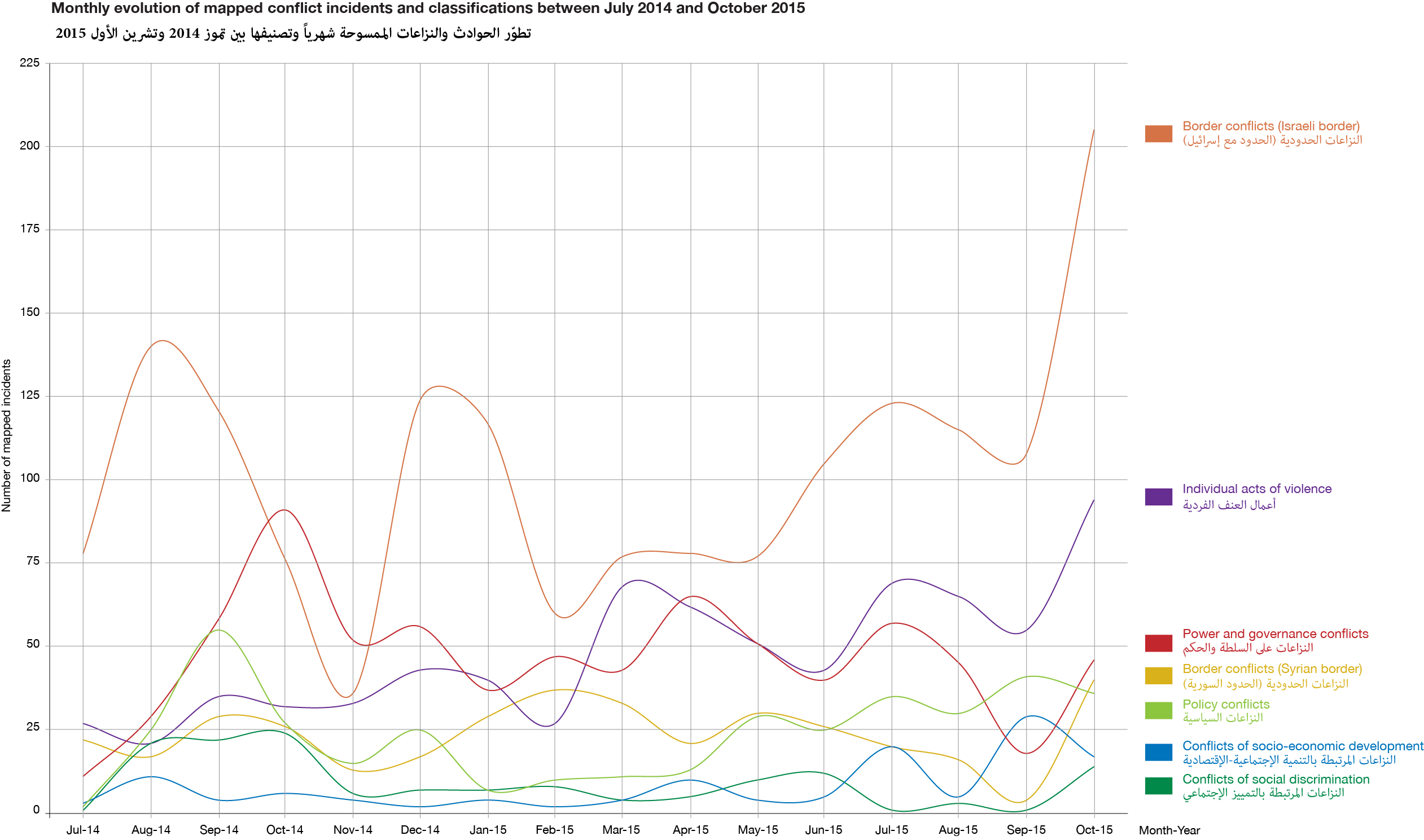
The above graph demonstrates the fluctuations of mapped conflict incidents between July 2014 and October 2015.
The vast majority of Israeli border violations are Israeli overflights violating Lebanese airspace. These are generally routine reconnaissance flights in violation of UN resolution 1701. However, there are also cases of Lebanese airspace being used for jets to launch missiles at targets inside Syria.
The Summer of 2015 saw spikes in conflicts of socio-economic development and policy conflicts. Many of these incidents were due to an influx of collective action movements which included strikes, sit-ins, and protests surrounding state policy and labour issues. Policy conflicts increased from July to October due to the waste management conflict, though these protests developed into a wider set of political grievances against the Lebanese government (see section 2 below). These policy conflicts are primarily located in Beirut due to it being Lebanon’s capital and the seat of government.
Cases of Syrian border violence, involving clashes between LAF and Hezbollah forces with militant groups from Syria noticeably dropped during the late summer of 2015.However, the month of October has seen a resurgence in violent incidents in Arsal such as bombings, suggesting a break from this trend. Furthermore, it is important to note that the majority of all power and governance conflicts occurred in Tripoli, Arsal and the wider Baalbek area, often involving militants from Syria. The Ras Baalbek timeline peaked from late January to late February 2015 with a total of 24 incidents from January 23rd to February 28th. Notably, 4 of these incidents occurred on January 23rd, 7 on February 25th and 8 on February 26th 2015. These three days in which the LAF mainly clashed with militants in Ras Baalbek accounted for over two thirds of the mapped incidents in the aforementioned time frame. Though the clashes are still ongoing, there has been a relative drop in violence, with only 3 incidents of clashes in Ras Baalbek in October. The Arsal timeline is on-going and rather consistent throughout time, though the number of incidents began to slightly decline in July 2015. Tripoli's timeline is also on-going though there has been a decline in incidents since June 2015. While there were 14 incidents mapped in May 2015, June only revealed 8 incidents, with violence dropping to an all time low in August, with only 3 incidents.Taken together, these categories show an enduringly high level of incidents occurring as spillover from the Syrian conflict. In the case of Arsal and Ras Baalbek (links lead to Spot On Events with interactive timelines and contextual articles), militant activity appears to be mainly due to militants retreating from conflict in Syria and being pushed into Lebanon, rather than deliberate ISIS or Nusra front strategy to attack Lebanon.
Furthermore, the security situation in the Palestinian refugee camp of Ain el-Helweh (link leads to Spot On Event on Ain el-Helwe) has deteriorated in recent months. It is important to highlight that tensions in the Ein el-Helweh camp have been ongoing at least in the last year, as shown in the interactive map and timeline. The violence has contributed to counts of Individual acts of violence and power and governance conflicts (for definitions of these categories follow this link). This is partly attributable to Palestinian refugees arriving in the camp from Syria which has contributed to the worsening of the socio-economic situation. The arrival of Palestinian refugees from Syria has reportedly contributed to exacerbate tensions, as shown in this report on Saida, although statistical data is still not available. As highlighted in a recent paper published by Lebanon Support, radicalisation trends in the camp are concomitant with ongoing mediation processes with the attempts to create and maintain a Joint Security Force in collaboration with the Lebanese Army. Moreover, the power and governance conflicts have primarily been between Fatah, as a security force,and Salafist groups, such as Jund al-Sham. Overall, there have been 18 number of individual acts of violence (incidents that do not have a specifically known political agenda) during the last quarter, with a total of 28 incidents since the beginning of the mapping exercise in June 2014. Since the beginning of our conflict mapping analysis, there have been 27 incidents coded in Ain el-Helweh, all mapped as power and governance conflicts. 15 of those incidents occurred during the last quarter, indicating a spike in violence in these months. 7 of these incidents were of hand grenades tossed by unknown individuals within the camp while 6 incidents included violence from militant groups identified as as Jund al-Sham and ISIS.These incidents appear to be occurring due to the deteriorating security situation in the camp and the struggles of day-to-day life for refugees.
Attack on Borj al-Barajneh
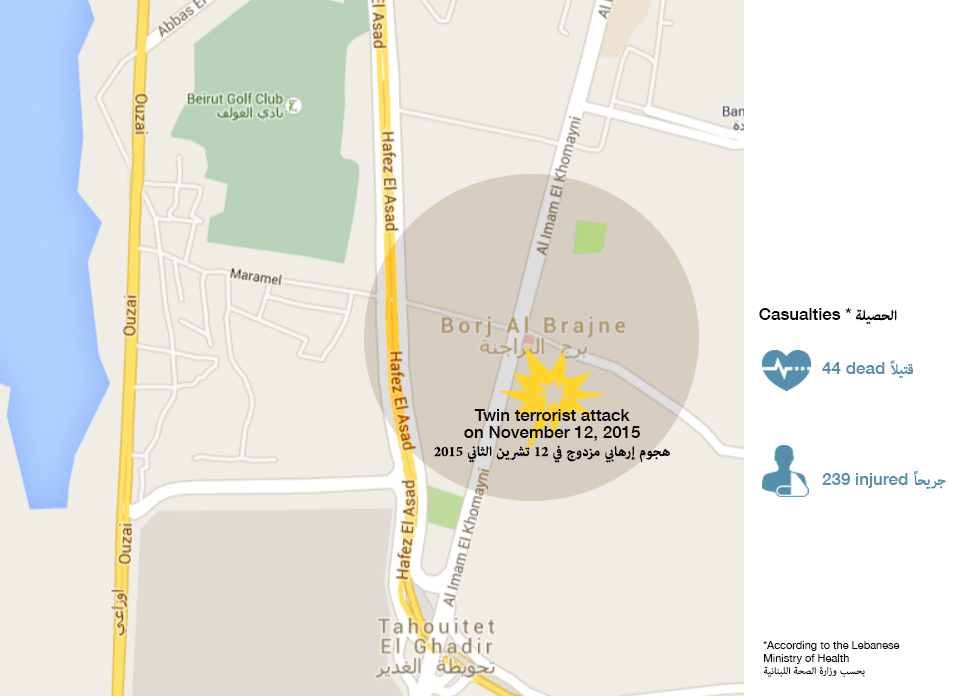
On November 12th, twin bombings were carried out by suicide bombers in the populous suburb of Borj al-Barajneh, located in Southern Beirut. The area is politically affiliated with Hezbollah and homes the Palestinian refugee camp of Borj al-Barajneh. It is equally important to note that the suburb is a popular commercial and residential area located off a major highway leading to the Beirut Rafic Hariri International Airport. Immediately after the explosions, the Islamic State published a statement claiming responsibility for the attack, stating that bombings were meant to target Shia “heretics” and Hezbollah supporters. Notably, the bombings coincided with the last day of the holy month of Muharram for Shias.
The explosions came during rush hour as people were finishing prayer at a nearby mosque. The first suicide bomber detonated 7 kilos of explosives in the midst of a crowd near a bakery while on his motorbike. Minutes later, as people rushed to the scene to see what happened, a second suicide bomber detonated 2 kilos of explosives approximately 50 meters away.
A government source noted that the second suicide bomber was headed towards Al-Hussein Mosque but was tackled by Adel Termos, a local of Borj al-Barajneh, when he detonated. While Termos did not survive the bombing, he reportedly saved dozens who were in the mosque at the time. The body of a 3rd suicide bomber whose explosives failed to detonate was also found at the scene of the attack.
Double bombings are an increasingly common tactic, as was seen in Tripoli in January. After one bomb detonates, another bomber exploits the situation by either waiting to detonate at a narrow escape point as people flee, or moving into a crowd that forms to help people hit by the first. Being mobile, the bomber is able to position themselves, given the reaction of the crowd to maximise the impact of the second blast.
The Ministry of Health has numbered casualties at 44 while over 230 were injured by the bombing, many left in critical condition. The explosions also caused great infrastructural damage, one witness recollecting that people were being “killed by glass and bricks falling on them.”
In response to the bombings, Prime Minister Tamam Salam declared the day after the bombings a national day of mourning while the Ministry of Education declared that all schools and universities will be closed as part of this mourning. The Ministry of Health also declared that all medical treatment of those injured in the bombings would be paid by the state.
Hezbollah top aide Hussein Khalil stated from the explosions site, “What happened here is a crime…This battle against terrorists will continue as it is a long war between us.” Addressing the bombing a day later, Hezbollah leader, Hassan Nasrallah stated that the attacks strengthened Hezbollah’s determination in its fight against the Islamic State (IS) in Syria while urging his supporters not to retaliate against Syrian refugees for IS’s atrocities.
Within 48 hours of the bombing, Interior Minister Nuhad Mashnouq announced that a terrorist network of 9 individuals were arrested in connection to the bombings. 7 of the suspects were of Syrian nationality while 2 were Lebanese nationals. Mashnouq went on to describe one Lebanese detainee, Ibrahim Jamal, as a would-be suicide bomber arrested in Tripoli when his explosive belt did not detonate. The Tripoli native told investigators that he was part of an ISIS cell that dispatched from Syria into Lebanon just 2 days before carrying out the bombings, though investigators have not verified this to date. The second Lebanese detainee, identified as A.S, helped smuggle 2 suicide bombers from Syria into Arsal. According to the National News Agency, upon raiding the trafficker’s house in Labweh, Bekaa, security forces seized counterfeit documents and a vehicle suspected of transporting the terrorists.
2 of the 7 Syrians arrested were described as supposed-to-be suicide bombers in the attack but did not assist in the bombings due to a change of plans.
On November 15th, General Security also arrested Ibrahim Ahmad Rayed, a Lebanese man, and Mustafa Ahmad Jaref, a Syrian, for funding and planning the Borj al-Barajneh bombings, though it is not clear whether these two arrests are included in Mashnouq’s 9 announced arrests.
Mashnouq further revealed that the smuggled bombers took refuge in the Borj al-Barajneh refugee camp and a flat in Ashrafieh where they assembled their explosive belts before carrying out the attacks. 5 suicide bombers were originally planning to enter Rassoul al-Aazam Hospital in Borj al-Barajneh but backed down from their plan due to heavy security surrounding the hospital.
While the incident and supposed infiltration of ISIS into Beirut has come as a shock to many, it is important to note that the Lebanese Armed Forces are constantly involved in clashes within the Bekaa Governorate, more specifically, in Ras Baalbek, Baalbek and Arsal. The steady presence of violence within Tripoli over the past few years due to the Syrian conflict has also been thought to breed jihadi sympathisers, allowing for the radicalisation of nationals, such as the Lebanese accomplices in custody. Notably, on the same day of the Borj al-Barajneh bombings, a 10 kg explosive device was found and dismantled by the Lebanese Armed Forces in Tripoli.
2. Conflict Trend: Focus on Collective Actions
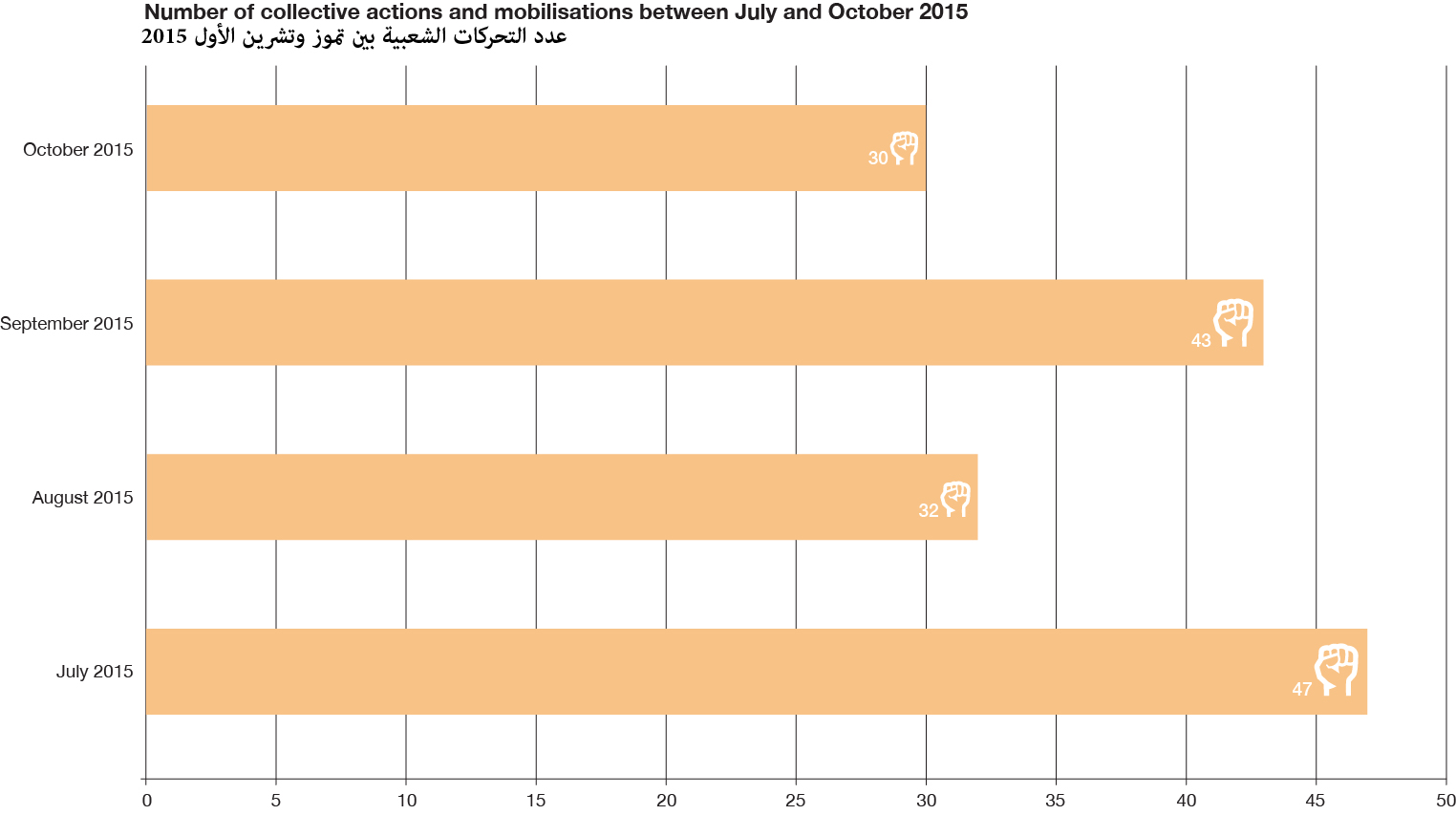
The above graph analyses Collective Actions that have taken place between the months of July 2015 to October 2015. Here, collective action encompasses, but is not limited to, actions such as sit-ins, protests, road blockages, and solidarity movements. In total, there were 152 cases of collective action incidents during the 4 months period, with 47 events taking place in July, 32 in August, 43 in September, and 30 in October.
The highest number of collective actions took place in July as it marked the beginning of thewaste management conflict prompted by the closure of the Naameh landfill on July 17th. From the conflict came countless protests, initially in Naameh, then in various locations all over the Lebanese territory. These anti-trash protests soon turned into anti-corruption protests with citizens demanding better living conditions and greater transparency from the government.
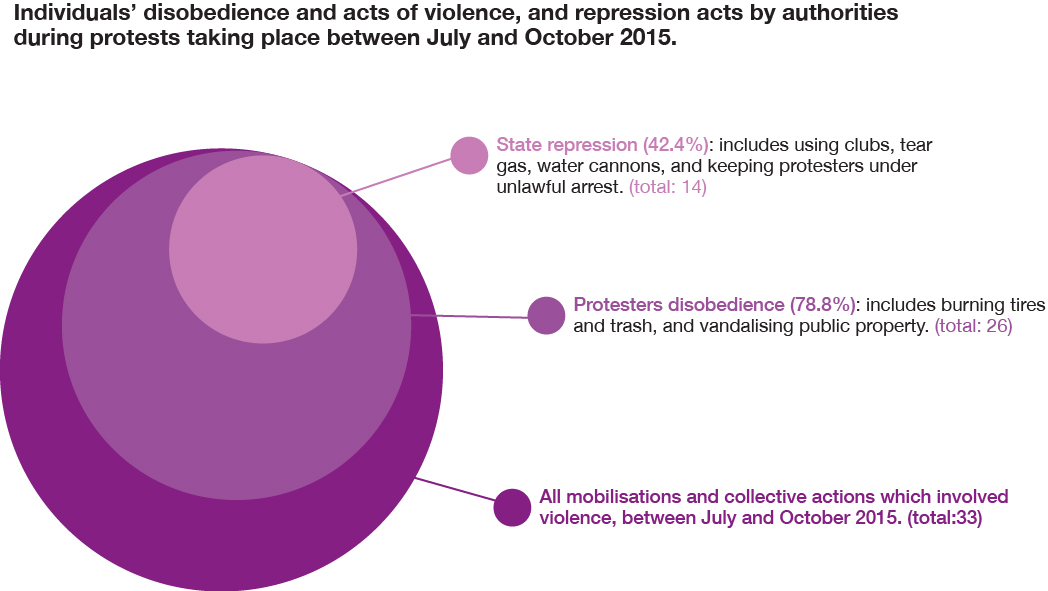
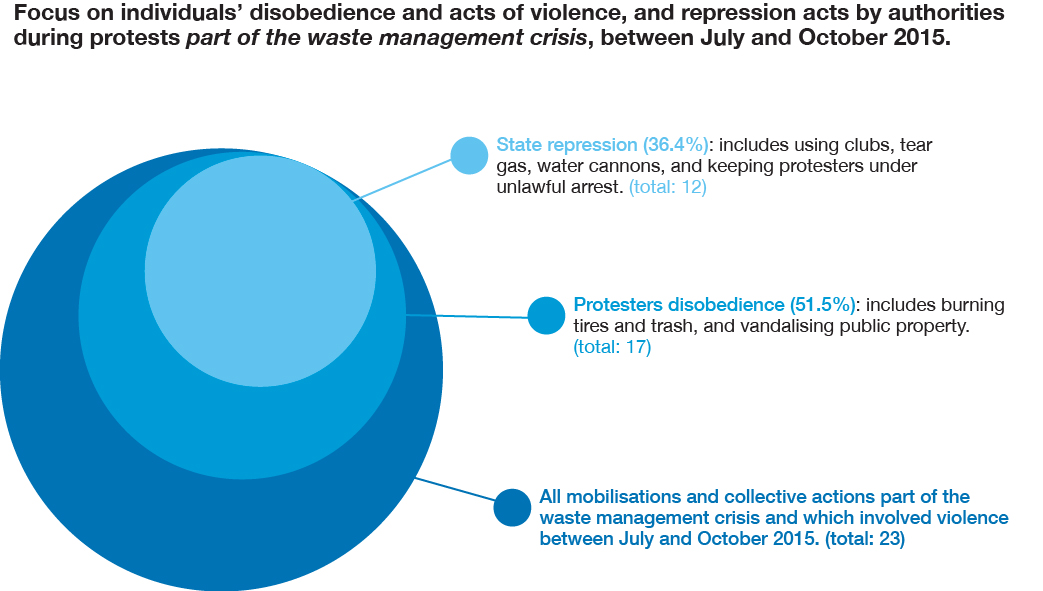
The graphs above show that mobilisations relevant to the waste management crisis involved violence the most, as opposed to other mobilisations such as the EDL workers or the families of soldiers kidnapped in Arsal. This can also be linked to the fact that most collective actions taking place between July and October had to do with the waste management conflict. 17 of these protests featured protester violence while 12 protests faced state repression. It is important to note that protester violence may be defined as civil disobedience such as protesters throwing and burning trash, as well as protesters burning tires to block roads. State repression is marked by the use of clubs, tear gas, and water cannons, while also taking into account unlawful arrests.
Notably, at least 90 protesters were arrested during these protests, with over 450 people, including ISF members, injured.
Cross-analysis ofthe numbers of collective actions in the last quarter and the increased recourse to violence from state apparatuses or some activist groups suggests a relative decrease in the number of protests, notably within the waste management crisis. In some contexts, state coercion - that has included, among others, disproportionate police violence, unlawful arrests of activists, but also infiltration of social movement by informants - has led to the radicalisation of protests, as it can be used by social movements as a political resource to push for their demands. Coercion may, as it has been observed in other coercive contexts, also lead to a certain degree of homogenisation of diverse groups participating in the same protest movement. However, the latest trends suggest that, in Lebanon, it may have contributed to dampen the waste management crisis movement. This trend may also be informed by the recourse to violence by rioters within the movement, which has led the campaign’s main organisers to distance themselves from the “troublemakers”, contributing to the creation of additional lines of fracture among the protesters and their sympathisers. The observation of the movement during the upcoming months will be crucial in understanding the long term effects of violence and repression on social movements’ tactics, strategy, and sustainability.
3. Featured report within the Conflict Mapping & Analysis project
Conflict Analysis Report - The conflict context in Beirut: the social question, mobilisations cycles, and the city’s securitisation | November 2015 Beirut
The featured report on Beirut provides an analysis of the history and current situation of the conflict context, actors, and dynamics in Beirut, Lebanon. The report includes a special focus on the social question, subsequent political and social mobilisation, gender issues, the securitisation of the city, as well as the interactions between the Lebanese host community and Syrian refugees and their unfolding within the last four years (since 2011). Read more.
4. Featured paper within the Conflict Mapping & Analysis project
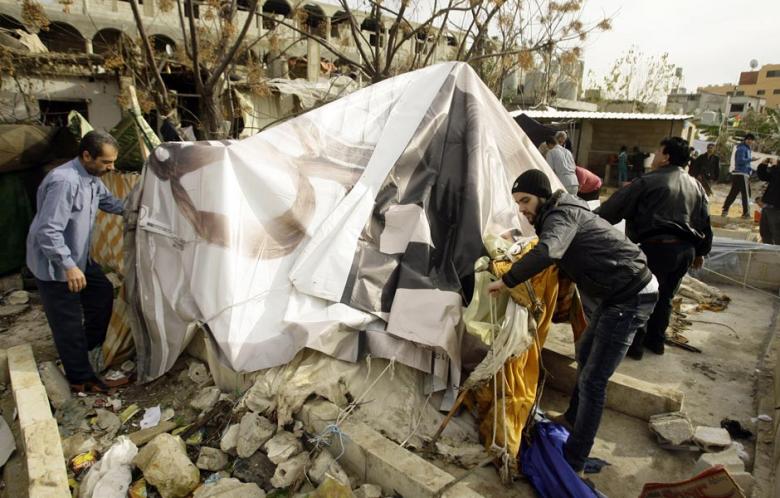
Between Radicalization and Mediation Processes: a Political Mapping of Palestinian Refugee Camps in Lebanon*
Palestinian refugee camps in Lebanon are often depicted as “no-law zones” that give rise to Salafist-Jihadist factions, and inter-related military networks between some Lebanese, Palestinian and Syrian groups. The Lebanese army and its intelligence apparatus are not in a totally antagonistic relationship with Palestinian actors and despite their divisions, Palestinian organizations, from Islamists to Nationalists and Leftists, cooperate with each other. This paper argues that an inter-Palestinian mediation process and a constant dialogue with Lebanese authorities are surely a precondition to face Salafist radicalization in Palestinian refugee camps in Lebanon. Read more
5. Featured data visualisations in Numbers & Figures
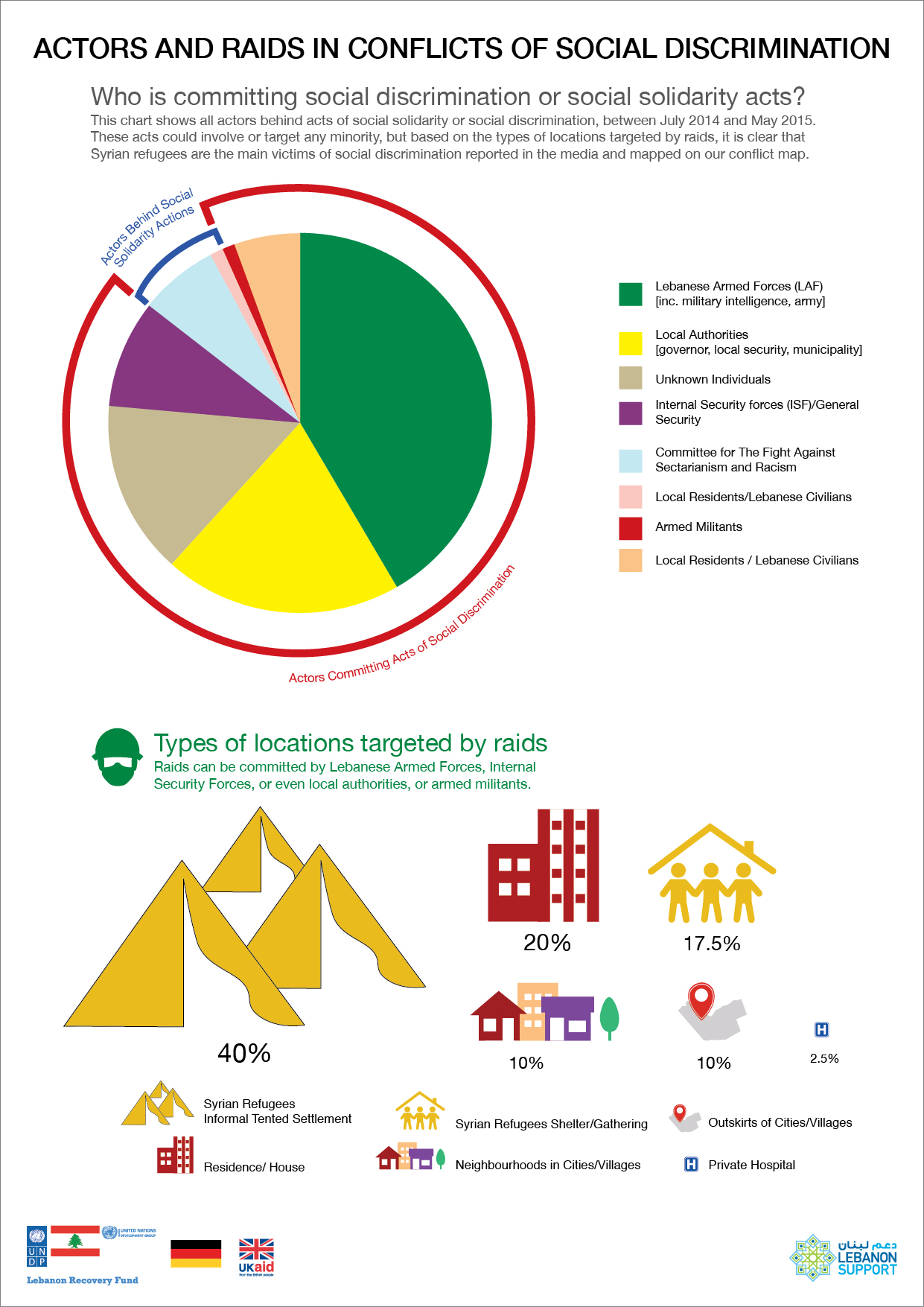
Actors and raids in conflicts of social discrimination

Overview of classifications of conflicts mapped over one year


Focus on mobilisations and collective actions in Lebanon
6. Featured Spot On Actors
 Israeli Military
Founding Date: May, 1948
Origins: The Israeli Military was officially established right after the founding of Israel on May 31st, 1948, and included pre-state Jewish paramilitary organisations (the Haganah, Palmach, Irgun and Lehi). The institution significantly developed in the first decades of the Israeli self-proclaimed statehood, by means of effective organisation, manpower and supply advantages, with the aim of ensuring the survival of the country and its people. Indeed, with the first Arab-Israeli war (May 1948-July 1949), the Israeli Military fully took on its role of “defense”, and what will later be encapsulated by the Israeli political elite as “survival”. Read more
 Committee of the Families of Kidnapped and Disappeared in Lebanon
Founding Date: October, 1982
Founder: Wadad Halwani, with other unknown relatives of disappeared.
Origins: The organisation was founded in 1982, seven years after the beginning of the Civil War, in response to the growing number of missing people. In 1982, Adnan Halwani, an official in the organisation for Communist Action in Lebanon, was abducted in the western portion of Beirut. His wife made a famous radio call to meet with other people in the same situation as her. Hundreds of people, mostly women, gathered after this call. A group of ten women managed to meet the Prime Minister Shafiq al-Wazzan at his residence. After this meeting, women decided to create the “Committee of the parents of the Disappeared” on October 25, 1982. Read more
7. Featured Spot On Events
Spot On Events focus on certain prominent and lasting conflicts aiming to give a broad, exhaustive overview of it, and feature interactive timelines of mapped incidents, contextual articles giving background information on the conflict, and, where it fits, actors discourses.
Arsal Conflict (starting August 2, 2014)
Tensions at Ain el-Helweh (starting August 7, 2014)
Waste Management Conflict (Starting January 25, 2014)