
Issue 2, April 2016
About the bulletin
The Conflict Analysis bulletin, part of the Conflict Mapping & Analysis project (CMA) is an initiative by Lebanon Support, with the support of the United Nations Development Programme (UNDP), available on the Civil Society Knowledge Centre (CSKC), Lebanon Support’s knowledge platform. It aims to make available and accessible information and research about conflicts in Lebanon, in order to better understand their underlying causes, and inform interventions and policy-making.
This bulletin highlights a selection of the latest publications on the CMA’s page, including papers, articles, reports, visuals, and interactive content such as a geo-located mapping of conflict incidents and timelines.. Additionally, the bulletin includes visualisations of main conflict trends during the last quarter.
Defining Conflict:Going beyond the view of conflict through a security framework associated with belligerency and violence, Lebanon Support upholds that conflict is of a socio-political nature. It thus sheds light on dynamics underlying a broad spectrum of violent and non violent contentions including social movements, passing by conflicts opposing minorities (ethnic, religious or sexual among others) as well as local, national or regional actors’ policies. Read more and check the interactive conflict map here.
1. Conflict Trends in Lebanon in 2015
Having started its mapping in June 2014, Lebanon Support has decided to take advantage of the fact that it has a year’s worth of data, from 1 January 2015 till 31 December 2015.
The following three visuals have been produced in this vein.
Lebanon, a year in conflict. A mapping of conflict incidents in 2015
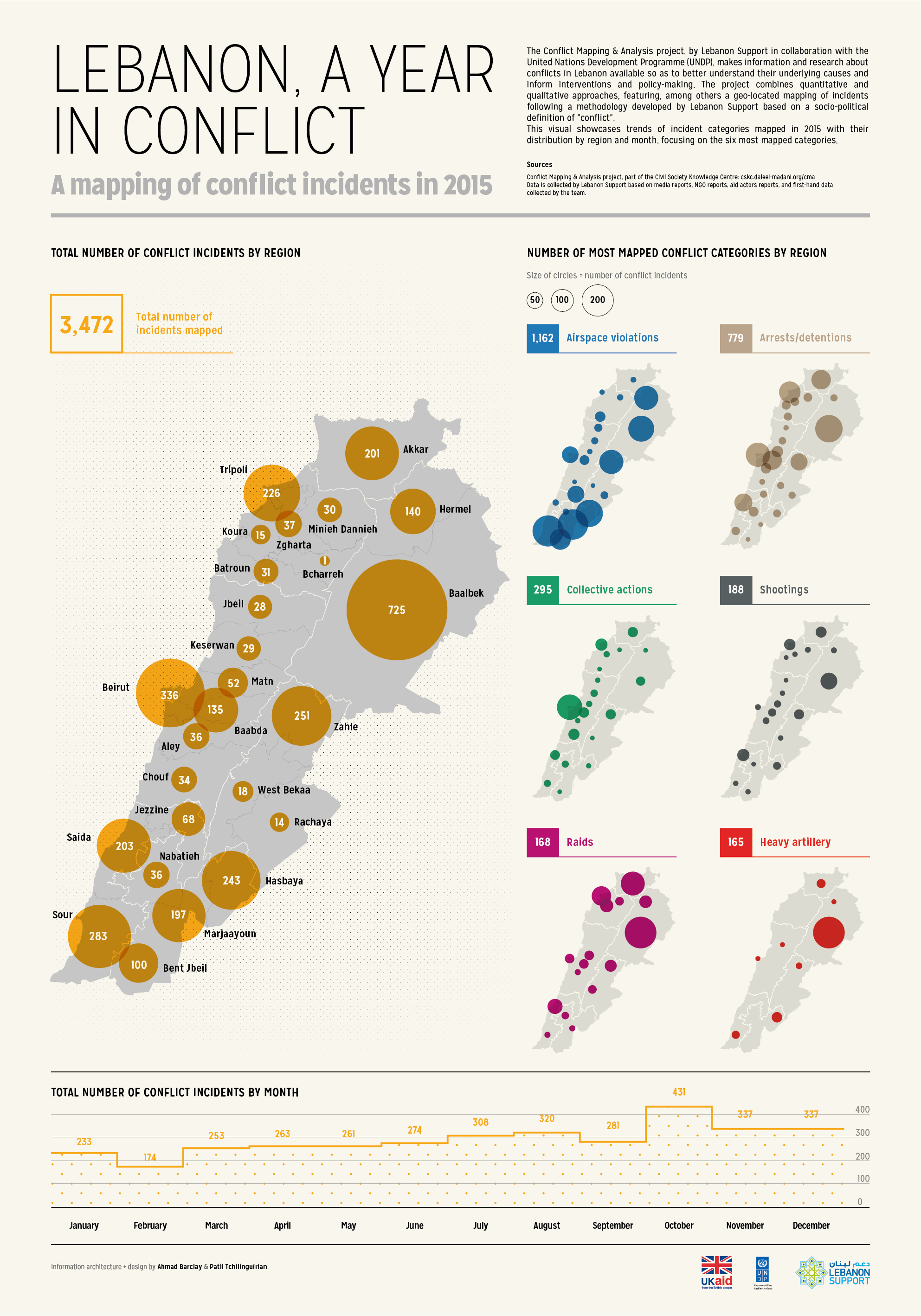
This visual gives a broad overview of mapping trends in 2015. It showcases incident categories mapped in 2015 with their distribution by region and month, focusing on the six most mapped categories.
The most mapped category, by far, is “Airspace Violations”, with over 1,000 incidents mapped. This category mostly involves Israeli Military violating the sovereignty of Lebanese airspace territory and can be considered an invisible conflict: it happens at a very frequent rate but is often ignored and not taken into consideration when issues of conflict in Lebanon are addressed.
“Arrests/Detentions” and “Raids” are respectively the second and fifth most mapped categories (779 and 168 mapped incidents) and highlight the presence and strength of State actors in spite of assumptions of “weak” or “absent” State.
It is also notable that the third most mapped category is “Collective actions”, which denotes the many mobilisations of people in Lebanon whether concerning the waste management conflict (see relevant timeline here), the EDL conflict (see relevant timeline here, and relevant actor profile here), the tenants/renters protests, protest of families of kidnapped soldiers (see investigative article here), etc.
Armed conflicts in Lebanon. Clashes/armed conflict incidents in 2015

This visual gives an overview of mapped “Clashes/Armed Conflict” incidents. This is a category used whenever two parties/groups are involved in armed back and forth exchanges. The heatmap shows where these clashes have taken place, whereas the timeline visualizes where and when these clashes have intensified. It is apparent that the majority of these incidents has taken place in Arsal.
The mapping of identified clashing actors allows to understand who has been involved in such clashes, whether State or non-State actors. For example, fighting in Arsal has involved the Lebanese Armed Forces (LAF) (see actor profile here) against militant groups like Islamic State (see actor profile here) and al-Nusra Front (see actor profile here), there were also clashes between Hezbollah and these militant groups, as well as inter-fighting between IS, al-Nusra, and Fateh Army.
Lebanon’s State response to illicit activities. Illicit trade/trafficking, arms storage/smuggling, and dismantlement of explosives mapped in 2015

This infographic focuses on the State’s response to the following illicit activities:
- “Illicit Trade/Trafficking/Smuggling” relevant to drug trafficking, counterfeiting of documents, or smuggling and trafficking of humans, and which is the most mapped type of illicit activity (60%);
- “Arms Storage/Smuggling” which refers to illegal trade of weapons or storage of large amounts of arms;
- and “ Dismantlement of Explosives” which denotes the efforts of State actors in dismantling any explosive devices or in demining.
The diagram maps out the frequency of each type of mapped activity per month, with the thickness of the funnel being directly related to the percentages of these activities. It shows their spread across the territory with maps showing their geo-locations. It finally links to the State actors that were involved in the response, whether it was an arrest or a raid, highlighting how the Internal Security Forces (ISF) and Lebanese Armed Forces (LAF) are taking the lead in responding to such activities. The visual highlights how the ISF are mostly involved in tracking down “Illicit Trade/Trafficking/Smuggling”, while the LAF’s efforts target all three types of illicit activity almost equally.
This infographic serves to show that in spite of a security situation deemed unsafe, State actors have in fact been responding to illicit activities that can be linked to conflicts of power and governance, or involving militant groups.
2. Featured papers within the Conflict Mapping & Analysis project
The Peaceful Settlement of Syrian Refugees in the Eastern suburbs of Beirut: Understanding the causes of social stability
By Marianne Madoré | March, 2016
Since early 2011, the few episodes of violence involving refugees in Lebanon have been covered extensively. Yet, given the high numbers of displaced people, the proximity of the battles, and the pre-existing pressures in Lebanon, one could have expected many more clashes to take place. This article focuses on the densely populated municipality of Bourj Hammoud, where the proportion of registered Syrian refugees has reached a fifth of the local population without leading to any major violent episodes. Based on extensive ethnographic study, this article explains the social stability that prevailed by highlighting mechanisms of regulation and control, the management of the influx of refugees by local actors, and the agency of the refugees themselves in the settlement process. Read more
Prisms of Political Violence, ‘Jihads’ and Survival in Lebanon’s Tripoli
By Estella Carpi | December, 2015
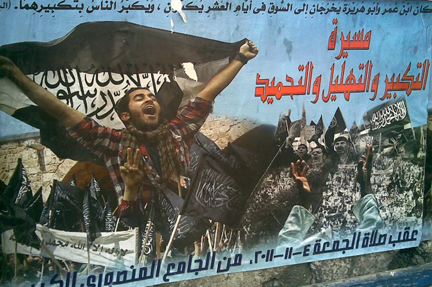
In the framework of the recruitment of Syrian and Lebanese fighters combating today in Syria, this paper aims to further problematise the processes in which individuals decide to disrupt their ordinary lives to engage with “Jihadist” armed groups. Such processes are frequently studied and tackled by government programmes and NGO practices aimed at the “rehabilitation” of former fighters in various countries ranging from Muslim majority states to European or North American states. Likewise, some terrorism scholars still tend to trace a linear path to identify the social and psychological causes which push individuals to join militant groups, and trace the causes which, in some cases, lead to subsequent disengagement from fighting and the ideology involved. This study rather shows the cyclic and changing nature of life choices and circumstances which influence Jihadist fighters and supporters. By doing so, it embraces the scholarly approach according to which “extremist” armed groups should be studied and understood as any conventional social group. In specific, this primary research is based on ten in-depth interviews conducted in the northern Lebanese city of Tripoli with Syrian and Lebanese ex-fighters, and with sympathisers of the so-called "Jihadi ideology" who never took up weapons. To interpret the narratives I collected, I will intentionally draw on both critical and mainstream security-focused bodies of literature on political violence, “radicalisation”, and extremism. While the experiences recounted by the ex fighters will be analysed through the two constructed categories of contingency and intentionality, the Jihadist supporters who never joined an armed group rather point to how there is no linear and unilateral progression from “extremist” beliefs to violence. The survival of such forms of political violence, ultimately, challenges the survival of politically biased knowledge and the programmes that the latter informs. Read more
3. Featured investigative article

Is justice for everyone? Arbitrary detention and torture of Islamists in Lebanon
By Camille Lons | March, 2016
Although it is difficult to clearly establish the link between “Islamists” and high rates of arbitrary detention and torture, the security and political context surrounding the issues make Islamists a particularly vulnerable population to arbitrary arrest, detention, unfair sentences, torture and ill-treatment. This article aims to understand the special circumstances of the “Islamists" case, and demonstrate the wide range of Human Rights violations perpetrated under the protection and guise of preserving State security. It is based on a series of interviews with lawyers, representative of Human Rights NGOs and a former detainee. Read more.