Issue 4, September 2016
*Scroll down for Arabic
About the bulletin
The Conflict Analysis bulletin, part of the Conflict Analysis Project is an initiative by Lebanon Support, with the support of the United Nations Development Programme (UNDP), available on the Civil Society Knowledge Centre (CSKC), Lebanon Support’s knowledge platform. The Conflict Analysis Project aims to make available and accessible information and research about conflicts in Lebanon, in order to better understand their underlying causes, and inform interventions and policy-making.
This bulletin features visuals focusing on conflict trends mapped during the second third of the year. It also highlights a selection of the latest publications on the project’s page, including papers, articles, reports, visuals, and interactive content.
Defining Conflict
Going beyond the view of conflict through a security framework associated with belligerency and violence, Lebanon Support upholds that conflict is of a socio-political nature. It thus sheds light on dynamics underlying a broad spectrum of violent and non violent contentions including social movements, passing by conflicts opposing minorities (ethnic, religious or sexual among others) as well as local, national or regional actors’ policies. Read more and check the interactive conflict map here.
1. Overview of conflict incidents mapped from May to August 2016

In comparison to the first third of this year and the months of September-December 2015, the months of May-August have seen a relative increase of incidents mapped. The surge in incidents is evident starting July and continuing into August, with over 500 incident mapped per month. This surge can be partly linked to the conflict incidents that took place in el-Qaa and surrounding areas (see our Spot On Ras Baalbeck clashes here and our visual on el-Qaa below). After the el-Qaa bombings, there was an increase of raids, arrests, and military deployment, most of which targeted Syrian refugees, which can be attributed to the sharp increase of incidents. As these arrests and raids mostly targeted Syrian refugees, these incidents can be tracked on our mapping of conflicts by using the “Border conflict (Syrian border)” classification which doubled in July-August to around 110 incidents, from around merely 55 incidents in May-June. To compare with the first four months of the year, raids amounting to 90 occurrences in Jan-April 2016 increased by 23% to 111 raids in May-August 2016.
853 incidents, just under half of the mapped incidents, occurred in either the Beirut or Bekaa areas. Furthermore, the 5 most mapped categories were, in decreasing order: arrest/ detention (714 incidents / 357 in Beirut), airspace violation (395 incidents / 165 in Nabatieh), raid (111 incidents / 49 in Bekaa), collective action (106 incidents / 42 in Beirut), and brawl/dispute (104 incidents / 37 in North Lebanon). 78% of all mapped incidents in the studied period fell under these categories, with the rest of the mapped incidents (22%) dispersed over 21 other categories (see our categories and classifications on our conflicts map). Notably, airspace violations, which are almost all carried out by the Israeli Military, jumped from 282 January through April to 395 in May through August. Furthermore, there was also a surge in arrests which numbered 456 in the first four months of the year, and jumped to 714 in the months of May through August. This is partly due to greater reports of arrests published by the ISF, with up to 35 arrests noted per report. These arrests are coded separately, and have been coming out once to twice a week, specifically by the ISF’s Beirut patrol.
The most mapped actors are the Internal Security Forces, Israeli Military, Lebanese Armed Forces, and Lebanese Civilians, which is very similar to the top actors involved in incidents mapped between January and April 2016.
2. Frequency of incidents by primary classification of conflict (from May to August 2016)

“Individual acts of violence” incidents have consistently been the most mapped classification of incidents May through August, with a surge in these incidents occurring in mid-June, continuing to peak in late July. These mostly consist of arrests/detentions taking place all over the Lebanese territory. Around 6% of the overall number of these arrests have a secondary classification of “Power & governance conflicts,” and are thus characterised by a defiance or opposition to the central state: these incidents can vary from being arrests of individuals trafficking large amount of drugs, to the LAF’s dismantlement of explosives. Most notably, 8 explosions were mapped and have taken place in arsal (3), Tripoli and el-Mina (3), Aabbasiye (1), and Ayn el-Helwe (1).
It is also important to note that the increase of “Individual acts of violence” correlate with the greater amounts of reports of arrests, as explained above in the previous visual analysis. Strikingly, at the end of June, there was a peak in “Border conflict (Syrian border)” with 36 incidents mapped in the last 4 days of the month, and 18 of these taking place on the 28th of June, the day after the bombings in el-Qaa. Half of these 18 incidents (9 incidents) were mapped with the secondary classification of “conflicts of social discrimination,” as the LAF raided and deployed to Syrian refugees’ encampments.
As consistently reported, there is a high frequency of “Border conflict (Israeli border)” mapped May through August, though, incidents began to diverge from the usual airspace violation category and rather also fell underneath other categories. Particularly, in August, taking into account primary and secondary categories, 15 of the mapped “Border conflict (Israeli border)” were sea border violations while 8 were land border violations. Furthermore, in August, 6 Israeli border conflicts were explosions, and most interestingly, 4 collective actions took place in Shebaa and Aarqoub in protest of Israeli breaches and expansion in neighbouring areas.
The decrease in “Policy conflict” compared to the first four months of the year can be attributed to a decrease in collective actions that have dropped from 211 in the period of January-April 2016 to 107 in the timeframe studied in this bulletin.
While this visual maps the frequency of primary classifications of conflict for mapped incidents, the secondary classification cannot be seen. Primary and secondary categories and classifications are either based on chronological order or a weighing system that takes into consideration the frequency of the event and its impact on society/state. As so, it is important to note that by large the greatest mapped secondary classification of conflict is “Power & governance conflicts”, with 138 mapped incidents being assigned this secondary classification. “Conflicts of social discrimination” is the second most used as secondary classification but with 50 counts, much less than “Power & governance conflicts.”
3. Focus on the el-Qaa bombings

On June 27th, two waves of suicide bombings occurred in the city of el-Qaa, starting 4:00 am and continuing on till 11 pm. Both waves of bombings included 4 suicide bombers. In total, this brings the number of suicide bombers during the el-Qaa bombings to 8.
Importantly, the bombers of el-Qaa employed a "double tap" strategy commonly used in drone strikes and terrorism. This strategy initially attacks a target in order to attract attention and have individuals gather in the targeted location. Once gathered, a second attack occurs to kill those who show up to aid or mourn victims. Interestingly, this tactic was also incorporated in the Borj al-Barajneh bombings of November 2015.
In response to the el-Qaa bombings, the Baalbeck Governor imposed a curfew on displaced Syrians as the LAF deployed and raided the area for suspects. In total, there were 18 raids and LAF deployments in the days following the attack, mostly targeting Syrian refugees and Syrian refugees encampments. It is worth mentioning that these raids occurred around the country and were not restricted to the el-Qaa and Ras Baalbek areas, with instances recorded in Tripoli, Arsal, Saida, and Zgharta, among others.
4. Featured reports within the Conflict Analysis Project

Formal Informality, Brokering Mechanisms, and Illegality. The Impact of the Lebanese State’s Policies on Syrian Refugees’ Daily Lives.
By: Lebanon Support | 2016
This report seeks to provide an overview of Lebanon’s current policy towards Syrian refugees, and to explore the new rules and regulations issued by General Security regarding the entry, residency, and departure of Syrian nationals. It also analyses the challenges pertaining to the current policy and its impact on the daily lives of Syrian refugees, with a special focus on their emerging illegality, their struggle for decent livelihood and working conditions, and increased informality and insecurity. Click here to read more and access the pdfs of both the English and Arabic versions

Crisis & Control, (In)Formal Hybrid Security in Lebanon.
By: Lebanon Support | 2016
This report aims to analyse how formal and informal security providers implement their respective social order agendas through a security “assemblage”. It also aims to inform the debate on refugee protection and security provision in urban settings, in the context of Lebanon’s hybrid security system. The accounts collected illustrate how state security institutions tacitly accept – or even rely on – informal security actors, managing at times to achieve their political and strategic goals through decentralised and/or illegal forms of control. In this vein, local municipalities imposed curfews and street patrols, which, far from being an institutional measure, follow a flexible and unpredictable pattern.
Three localities have been selected for the purpose of this research - namely Aley in Mount Lebanon, Ebrine in North Lebanon, and Shebaa in South Lebanon. The choice of these localities was driven by their different political and social history, their demographic homogeneity or diversity, and their relationship with surrounding regions.
This report was developed within the framework of the Lebanon Support project – “Urban refugee protection in Lebanon’s hybrid security system: a research and action agenda” – in partnership with International Alert and with the support of WOTRO-NWO. Lebanon Support's info-graphic (In)Formal Hybrid Security in Selected Areas in Lebanon is based on this report, so is the policy brief by International Alert Security That Protects: Informing Policy on Local Security Provision in Lebanese Communities Hosting Syrian Refugees.
Click here to read more and access the pdfs of both the English and Arabic versions.
5. Featured Spot On Actors within the Conflict Analysis Project
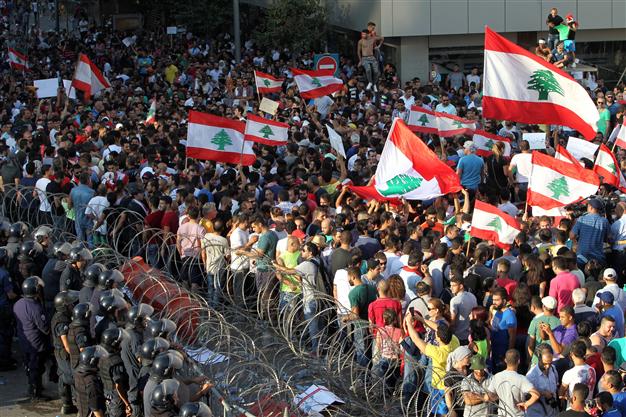
Social Movement responding to the Lebanese Garbage Crisis
In the summer of 2015, waste piled up in the streets of Beirut and Mount Lebanon, which marked the beginning of a renewed garbage crisis. The immediate trigger for this crisis was the protests of the residents living close to the then operating landfill site of Na’ameh. Click here to read the full actor profile.
Beirut Madinati
Beirut Madinati is a “local, political movement,”* founded in autumn 2015 by a group of academics, mainly from the American University of Beirut (AUB), and activists, a few months before the municipal elections in Beirut. The initiative came out of Lebanon’s waste management movement, which protested against the government’s inaction in sustainably managing waste in the country, instead allowing for trash to pile up on streets throughout Lebanon. Click here to read the full actor profile.
6. Featured article within the Conflict Analysis Project
The Military Establishment and Society: The Lebanese Armed Forces’ Legitimacy in a Confessional State and Society
By: Marie Kortam | August, 2016
This article analyses the different perceptions that the people of Tripoli have of the Lebanese Armed Forces. These perceptions have undergone three phases that we deem crucial, as part of the evolution of ties between the military establishment and civilians. In the early stages, this civil-military relationship was one of rupture, daily confessional clashes, and lack of trust in the LAF. The second phase was dominated by cautious communication and interaction for the restoration of civil and social peace and the regain of mutual trust. In the third and last phase, the United Nations and the international community imposed a new military model with a new civil conceptualization of security and its role within societies aimed at building safe and sound ties between the military establishment and civilians. Click here to read more.