Issue 5, January 2017 - العدد رقم ٥، كانون الثاني ٢٠١٧
*Scroll down for Arabic - للنشرة في اللغة العربية انظر(ي) إلى الاسفل
About the bulletin
The Conflict Analysis bulletin, part of the Conflict Analysis Project is an initiative by Lebanon Support, with the support of the United Nations Development Programme (UNDP), available on the Civil Society Knowledge Centre (CSKC), Lebanon Support’s knowledge platform. The Conflict Analysis Project aims to make available and accessible information and research about conflicts in Lebanon, in order to better understand their underlying causes, and inform interventions and policy-making.
This bulletin features visuals focusing on conflict trends mapped during the last third of 2016. It also highlights a selection of the latest publications on the project’s page, including papers, articles, reports, visuals, and interactive content.
Defining Conflict
Going beyond the view of conflict through a security framework associated with belligerency and violence, Lebanon Support upholds that conflict is of a socio-political nature. It thus sheds light on dynamics underlying a broad spectrum of violent and non violent contentions including social movements, passing by conflicts opposing minorities (ethnic, religious or sexual among others) as well as local, national or regional actors’ policies. Read more and check the interactive conflict map here.
1. Overview of conflict incidents mapped from September to December 2016
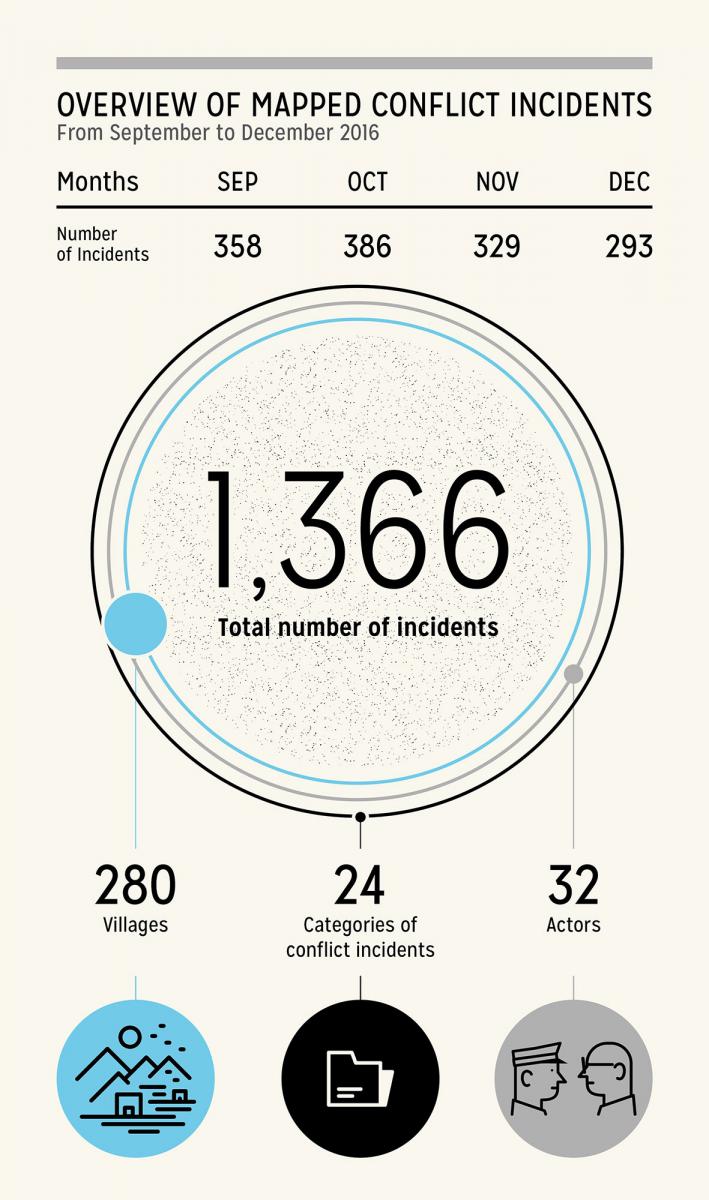
The last third of 2016 – the months of September-December – has seen the least number of incidents since the beginning of the year at only 1,366 conflicts mapped, though the number of villages, categories of conflict incidents, and actors mapped throughout the year have stayed relatively consistent. However, it is important to note here that Lebanon Support’s mapped conflicts for the months of January-April 2016 only surpassed this number by 41 incidents, while the second third of the year, or the months of May-August 2016, stands out as an outlier with 1,832 conflict incidents mapped.
Taking a closer look at the data, it is interesting to note that South Lebanon was the governorate with the greatest number of incidents in the last third of the year, with 284 conflict incidents mapped in the region. Of these incidents, 87 incidents are Individual Acts of Violence and 134 incidents are Israeli Border Conflicts, heavily categorised as airspace and sea-border violations, although also including incidents of bombardment and land violations. North Lebanon and Bekaa closely followed the South governorate, with 272 (147 Individual Acts of Violence) and 267 (110 Individual Acts of Violence) incidents respectively.
Most importantly, Beirut governorate had the least amount of incidents recorded with only 177 incident (96 Individual Act of Violence) mapped from September to December. This is the first time in 2016 where incidents mapped in Beirut have fallen underneath 200 in a four months period and is partially due the fact that Individual Acts of Violence Conflicts, such as individuals’ arrests, are not being as thoroughly reported by Internal Security Forces and other law enforcement groups within Lebanon. Even so, arrest/detention was the most mapped category in the last third of 2016 with 435 incidents. This is followed by, in decreasing order: airspace violation (247 incidents), collective action (149 incidents, refer to the ‘focus’ visual below), raid (79 incidents),and brawl/dispute (77 incidents). These top five mapped categories were the same in May-August 2016, with only collective action and raid switching slots. 72% of all mapped incidents in the studied period fell under these categories (see our categories and classifications on our conflicts map).
The most mapped actors are the Israeli Military, Internal Security Forces, Lebanese Armed Forces, Lebanese Civilians, and Palestinian civilians, the latter having emerged as one of the most mapped actors. This can be attributed to 70 incidents occurring in the Ain el-Helwe refugee camp. Of these incidents, 11 were collective actions, where Palestinians within the camp were protesting growing violence within their community, as well as socio-economic grievances such as water cuts (for more on collective actions, refer to the ‘Focus’ visual below).
2. Frequency of incidents by primary classification of conflict (from September to December 2016)
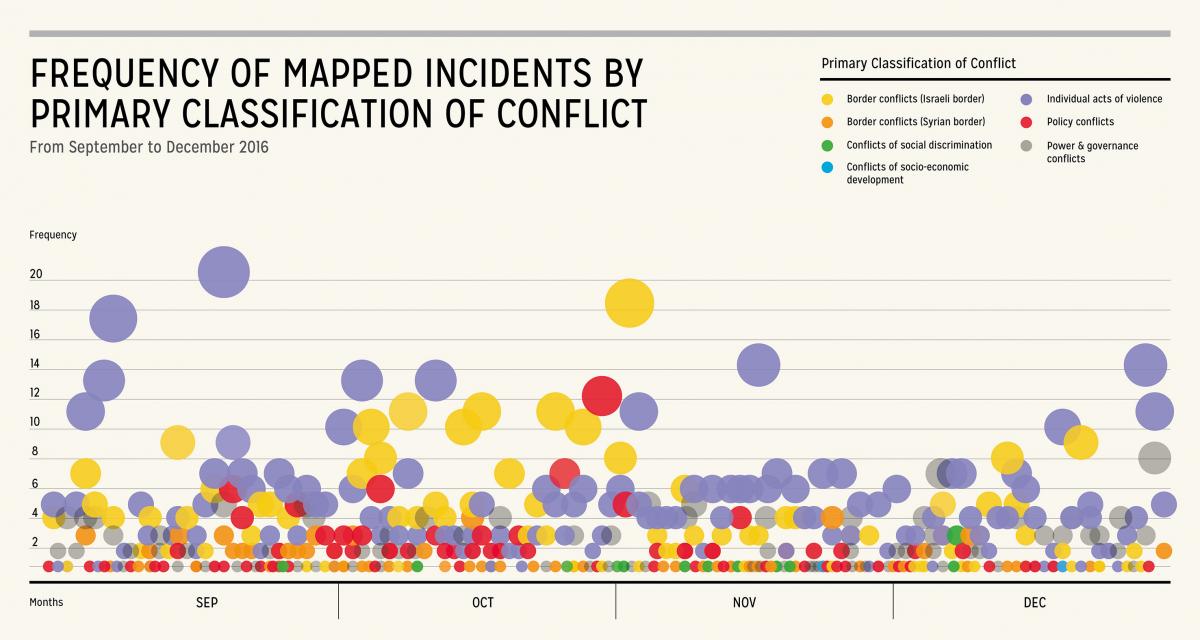
Individual acts of violence and Border conflicts on the Israeli border have consistently been the most mapped classification of incidents since the beginning of the year.
This is consistent with conflict trends recorded over the year 2015, which saw Airspace violations mostly by Israeli Military, arrests/detentions, shootings, and raids – all three of which can be classified as individual acts of violence – as part of the most mapped conflict categories. On the one hand, this corroborate Israeli border conflicts as the ongoing invisible conflict; and on the other, it highlights the response of state actors towards individual acts of violence and crime in general.
It is noteworthy to point out that the most mapped secondary category over September-December 2016 was illicit trade/trafficking, which can also explain the high frequency of individual acts of violence, as well as the spike in Power and Governance December 30th, on which the ISF arrested multiple individuals at the Rayak checkpoint for possessing quantities of cocaine.
Though incidents of Conflicts of Social Discrimination in the primary classification, as seen above, only total for 14 incidents in the months of September-December, conflicts of social discrimination rise to a total of 56 incidents (including 25 raids) when taking into consideration both the primary and the secondary classification. These 56 conflict incidents highlight unjust treatment of individuals or groups, related to a lack of protection and rights, inefficiency of the justice system and persisting social and economic vulnerabilities. This social discrimination is based on race, age, gender, sexuality, or other characteristics of one’s identity. As such, this classification includes restrictions on residents (inc. curfews), usually affiliated with curfews on Syrian refugees, collective actions, and gender based violence (GBV). Most notably, 13 of the 23 incidents mapped as gender based violence (inc. domestic violence, prostitution, etc.) in 2016 occurred in the last third of the year which may be attributed to the fact that there has been more focus and media revolving around women’s rights and gender issues in the last few months, especially taking into consideration the 16 days of activism against gender based violence and the repeal of Article 522 of the Lebanese Penal Code, which allows rapists to get away with their crime if they marry their victims. See our last Gender Bulletin for more on this.
While Policy Conflicts were prominent in the 1st third of the year, this last third witnesses a significant and consistent surge of these incidents, especially in the month of October which has seen a number of collective actions all over the country relevant to public transportation, with public drivers organising strikes, but also to demonstrations in support of political figures, most notably after the election of Michel Aoun as president and the nomination of Saad Hariri as prime minister, with their supporters rallying in celebration on the 31st of October for the former and the 3rd of the November for the latter.
More on these collective actions can be seen in the following visual.
3. Focus on mapped collective actions (from September to December 2016)
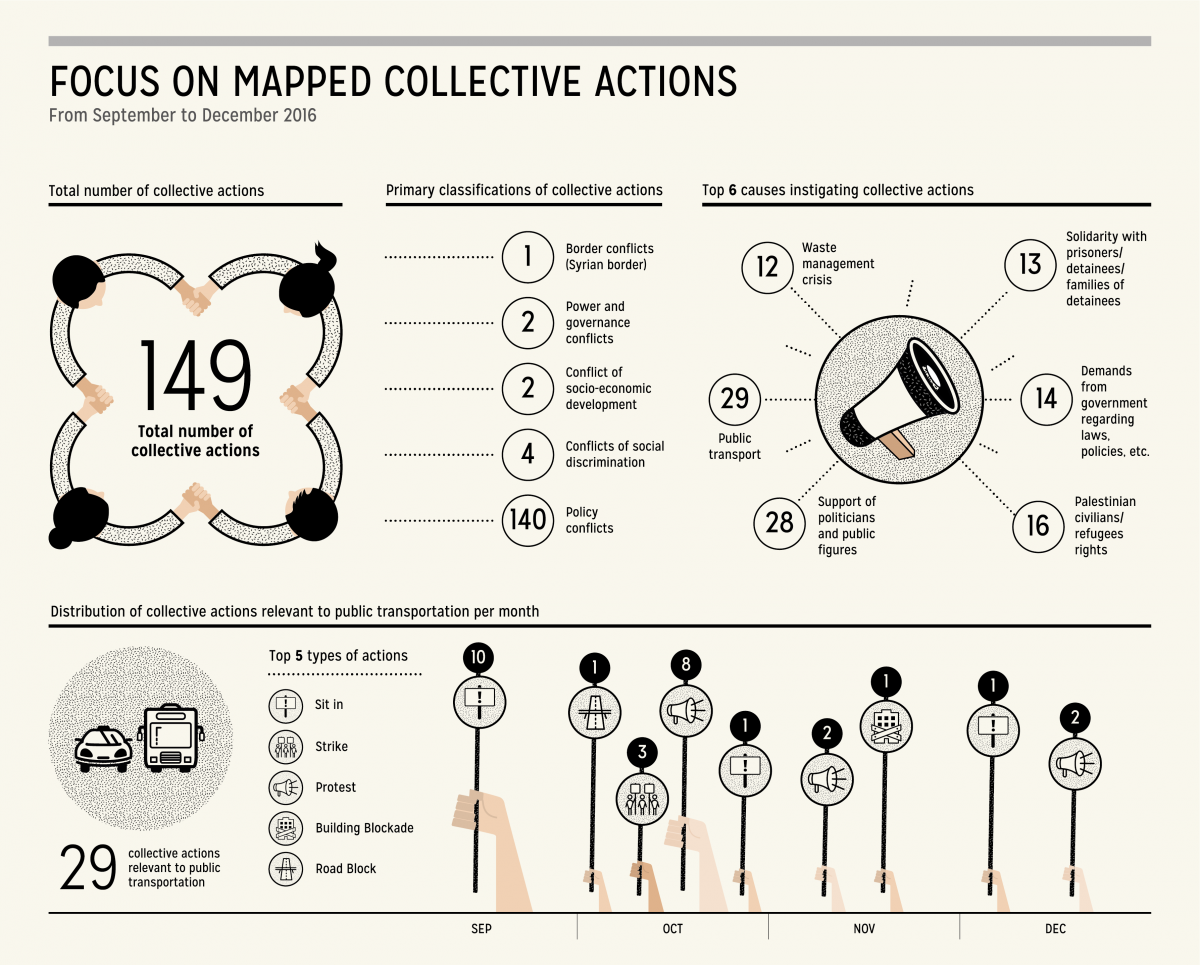
As the above visual shows, there were 149 collective actions that took place in the months of September-December 2016, very close to the 146 collective actions mapped in the same months in the year 2015. This last third of the year 2016 does show a 50% increase of social mobilisations, compared to the previous period of May-August 2016, when only 107 collective actions were mapped.
Overall, the 149 collective actions are overwhelmingly linked to policy conflicts, as the causes for which people mobilised attest. The greatest amount of collective actions were relevant to public transportation with taxi and bus drivers organising demonstrations since September against the privatisation of mandatory vehicle inspection centres and a fee hike of over 50%. The centres were initially founded by the government, but recently, the centres have turned to outsourcing management to private firms. As such, public drivers, many a part of the Public Driver’s Union or the Union and Leagues of Land Transport, have organised sit ins, protests and strikes held across the country, at times also blocking roads and entrances to centres. These demonstrators demand the government take back the management of all their facilities.
As mentioned previously, Palestinian civilians/refugees were involved in many collective actions, 11 of which took place in Ain el-Helwe and are linked to the deterioration of the security situation in the camp and quality of services provided by UNRWA, which suspended its work December 31st in the camp indefinitely due to ongoing gun violence and volatility within Ain el-Helwe between rival factions. It is important to note here that while the building of a security wall surrounding the camp was covered heavily by media and human rights groups throughout November, only one protest occurred against the building of the wall, which was then halted by late November. In the Beddawi camp, 5 protest took place with Palestinian refugees and Palestinian refugees from Syria mobilising for more aid and better provision of services by UNRWA. Such mobilisations balance a widespread preconceived idea of all refugees being passive and rather highlights demands for increased agency among the refugee populations, especially Palestinian refugees.
Mobilisations relevant to the waste management crisis and other demands from government, relevant to better public services, public spaces, and women’s rights, are still ongoing, with a surge in protests specifically linked to detainees and prisoners, for example the case of the mother detained in custody dispute which received high media coverage or mobilisations of families of detainees, which underscores how the legislative system is being challenged.
4. Featured resources within the Conflict Analysis Project

Access to Healthcare for Syrian Refugees. The Impact of Fragmented Service Provision on Syrians’ Daily Lives.
By: Lebanon Support | 2016
This report aims to explore the fragmented organisation of healthcare services in Lebanon, for Syrian refugees. Although it is not an assessment of the Lebanese healthcare system, this report does nevertheless reflect on the challenges and underlying dynamics of the current Lebanese system, which are reproduced in the healthcare provision for Syrian refugees. In this sense, the report highlights the privatised, rather ad hoc, and irregular provision of healthcare in Lebanon, notably for Syrian refugees, which tends to take on a more curative rather than preventive approach, resulting in significant costs on the patients. Consequently, a great number of vulnerable Lebanese and non-Lebanese residing in Lebanon, notably Syrian refugees, are unable to access health services. It is the third of a series of reports published in 2016, the 1st of which being "Formal Informality, Brokering Mechanisms, and Illegality. The Impact of the Lebanese State’s Policies on Syrian Refugees’ Daily Lives." and the 2nd "Syrian Refugees' Livelihoods. The Impact of Progressively Constrained Legislations and Increased Informality on Syrians’ Daily Lives."
Click here to read more and access the pdfs of both the English and Arabic versions of the report on health.

"A Shoulder to Lean On.” Towards Rights-Based Interventions and Policies for Syrian Refugees in Lebanon.
By: Lebanon Support | 2016
This policy brief analyses the socio-political implications of the so-called October policies, and suggests legislative, political, and practical measures to improve the situation of Syrian refugees in Lebanon. It also aims to inform policy formulation regarding Syrian refugees from a human rights-based perspective, while discussing modalities for enhanced programming at the civil society level.
Click here to read more and access the pdfs of both the English and Arabic versions.

The Conflict Context in Tripoli: Chronic Neglect, Increased Poverty, & Leadership Crisis.
By: Lebanon Support | 2016
This report provides an analysis of the current political, social and economic dynamics in Tripoli, Lebanon. The analysis begins with a brief overview of Tripoli’s history in the 20th century and the state’s securitisation efforts to contextualise the current social and political landscape. The report particularly focuses on how state policy towards the city, along with Tripoli’s special historical relationship with Syria, has contributed to ongoing armed conflict, economic stagnation, poverty and political fragmentation in Tripoli.
Click here to read more and access the pdf.
5. Featured Numbers & Figures within the Conflict Analysis Project

How can Syrian refugees in Lebanon access legal residency status and livelihoods?
This visual summarises findings from research by Lebanon Support looking into the impact of the Lebanese government's policies on Syrian refugees' daily lives, and highlights the options available to Syrian refugees to access legal residency status and the labour market, as well as the authority figures they have to deal with, and the challenges and implications of these circumstances.
Click here to read more and access the high resolution visual.