Issue 6, March 2017
About the bulletin
The Conflict Analysis bulletin, part of the Conflict Analysis Project is an initiative by Lebanon Support, with the support of the United Nations Development Programme (UNDP), available on the Civil Society Knowledge Centre (CSKC), Lebanon Support’s knowledge platform. The Conflict Analysis Project aims to make available and accessible information and research about conflicts in Lebanon, in order to better understand their underlying causes, and inform interventions and policy-making.
This bulletin features visuals focusing on conflict trends mapped during the last third of 2016. It also highlights a selection of the latest publications on the project’s page, including papers, articles, reports, visuals, and interactive content.
Defining Conflict
Going beyond the view of conflict through a security framework associated with belligerency and violence, Lebanon Support upholds that conflict is of a socio-political nature. It thus sheds light on dynamics underlying a broad spectrum of violent and non-violent contentions including social movements, conflicts opposing minorities (ethnic, religious or sexual among others) as well as local, national or regional actors’ policies. Read more and check the interactive conflict map here.
1. Overview of conflict incidents mapped from January to December 2016
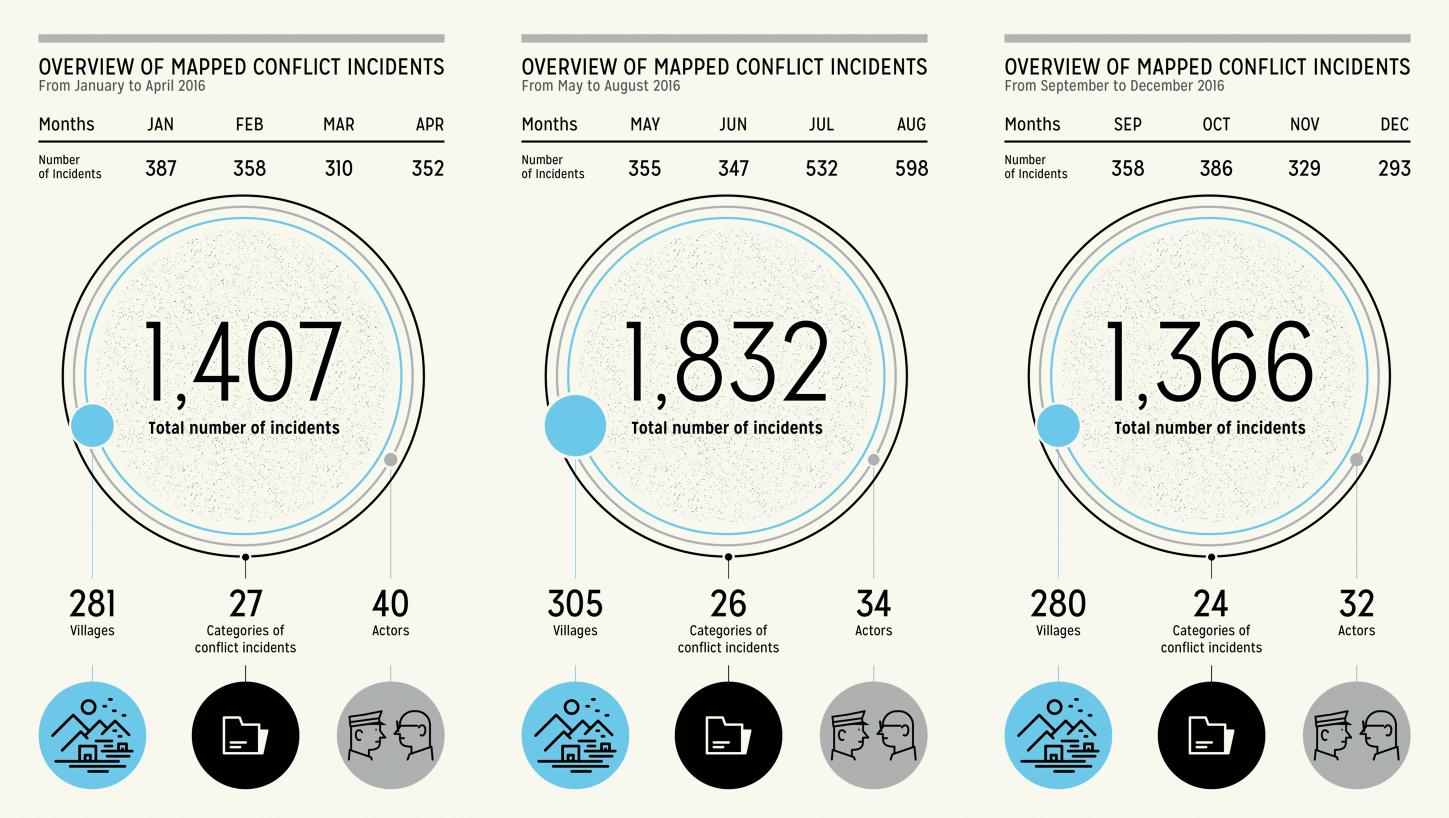
In total, there have been 4,605 incidents mapped in 2016, as compared to the 3,502 incidents mapped in 2015. This increase in incidents can be attributed to both greater consistency in Lebanon Support’s mapping of incidents, as the Geolocated Mapping of Conflicts in Lebanon has grown over time, and greater reporting by law enforcement officials regarding their activities and the general security situation in the country.
Over the period of 2016, Lebanon Support detected recurring trends in the mapped data:
- Brawls/disputes were a recurring category in many coded incidents over 2016 and it became increasingly noticeable that such incidents should not be dismissed as minor conflicts. In 73% of cases, brawls/disputes coded in our system developed into a shooting incident, with nearly half of these resulting in injury or death.
- Fluctuations in the reported number of raids and arrests/detentions often coincided with sudden increases in LAF operations which occur in the wake of major national events that threaten national security, such as the el-Qaa bombings.
- In 2016, there was an increasing trend in non-violent collective actions [inc. protests, solidarity movements...]. Of the 463 collective actions, only 3 resulted in 1 or more injuries. This is a positive development from 2015 which saw less collective actions (310 incidents) but a higher concentration of injuries and/or violence, totalling 27 casualties from 6 separate incidents.
- Throughout 2016, we saw a significant decline in policy conflicts in the latter half of the year compared to the January-June period. In fact, while there were 93 incidents coded as policy conflicts in January-June, there were only 59 policy conflicts mapped in July-December.
Taking a look at 2016, it is important to note that July and August saw particularly high numbers of coded incidents in the year. In July, 215 out of 532 total incidents,were categorised as arrests/detentions, while in August, 254 out of 598 incidents were coded as such, which makes the total amount of arrests/detentions amount to 469 in these 2 months alone. Of these 469 arrests, 174 incidents were also categorised as illicit trade/trafficking/smuggling, usually related to drug use and possession of illegal substances. This is particularly significant taking into account that the average number of arrests mapped in the other 10 months of 2016 had only amounted to approximately 90 arrests/detentions per month, 55 of these incidents also having the secondary category of illicit trade.
Focusing on the locations where the most incidents occurred in 2016, the top 5 districts (cazas) were Beirut (with 818 incidents), Baalbek (699 incidents), Sour (405 incidents), Saida (285 incidents) and Tripoli (213 incidents). It is important to note that the nature of these conflicts varied depending on their location. For example, while Beirut witnessed 534 Individual Acts of Violence, 134 Policy Conflicts, 73 Power & Governance Conflicts, 38 Border Conflicts (Israeli border), 20 Border Conflicts (Syrian border), 12 Conflicts of Socio-economic Development, and 7 Conflicts of Social Discrimination (all primary classifications), in Baalbek, classifications of conflict were dispersed with less discrepancy among the types of conflict with 249 Individual Acts of Violence, 210 Power & Governance Conflicts, 149 Border Conflicts (Syrian border), 72 Border Conflicts (Israeli border), 13 Policy Conflicts, and 6 Conflicts of Social Discrimination. Notably however, there were no Conflicts of Socio-economic Development mapped in Baalbek. This disparity in classifications between the two districts reveals that while Beirut faces greater conflict related to social and legal issues, such as socio-economic grievances, discrimination and policy, Baalbek faces greater Power & Governance conflict that often relates to border insecurity (Israeli and Syrian), as well as greater armed violence by transnational groups, armed militants, family groups and individuals who directly defy state authority. For a more in-depth analysis of conflict in the Baalbek region, see the Arsal timeline here and the Ras Baalbek timeline here.
2. Frequency of incidents by primary classification of conflict (from January to December 2016)
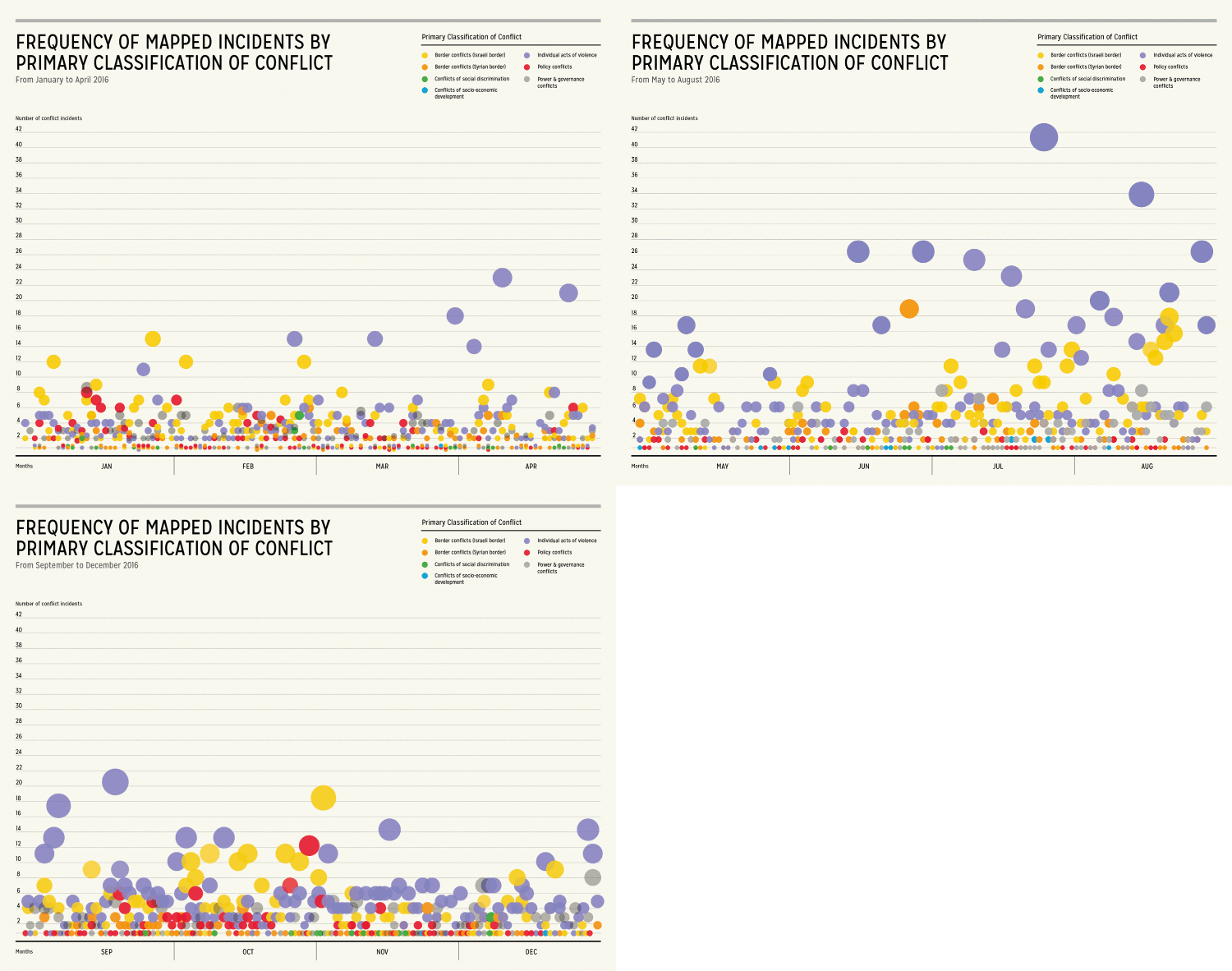
The most frequently mapped primary classification of incidents in 2016 were Individual Acts of Violence with 1,884 incidents mapped as such in the primary classification. Corresponding with the peak in incidents, specifically arrests/detentions, mapped in the months of July and August (see above), the frequency of incidents classified as Individual Acts of Violence as the primary classification witnessed an all time high with 42 Individuals Acts of Violence occurring July 27th. Analysing this surge, a high number of incidents can be traced to Beirut where thirty five arrests/detentions occurred following a large scale police operation pursuing wanted offenders and enforcing vehicle and traffic related infringements. Similarly, in the months of September, November and December, surges coincided with patrols in the region resulting in a large number of arrests/detentions that classified as Individual Acts of Violence.
The second most frequently coded classification were Border Conflicts (Israeli Border) with 1,190 recorded incidents throughout 2016. Border Conflicts as they relate to Israel are consistently recorded throughout the year, however surges, such as that which occurred on July 23rd, are often caused by air space violations by the Israeli Military over multiple locations in Lebanon. Each location that a drone or plane breaches is recorded as a separate incident and thus, seventeen air space violation incidents in one day can occur as it did on the 23rd.
Power and Governance Conflicts were mapped 646 times in 2016, across all regions of the state. While there were a few minor surges in this category, none were noted as outliers. Power and Governance Conflicts are our most consistent classification, with incidents being coded regularly and with no particular concentration of governorate or caza.
The fourth most frequented classification in 2016 were Border Conflicts (Syrian Border), reaching 453 incidents. For this primary classification, there was a surge on the 28th June with 18 separate incidents immediately following the el-Qaa bombings. Seven of these incidents were categorised as raid, 6 as arrest/detention, 4 as military/security forces deployment, and 1 as dismantlement of explosives/demining. These raids, arrests/detentions, military/ security forces deployment can be attributed to a widespread Lebanese Army operation targeting Syrian refugee encampments in Eastern Lebanon, particularly in the Marjayoun and Baalbek regions on 28th June 28th and the days that followed. For example, in one such recorded incident, a Lebanese Army patrol led to the arrest of one hundred and twenty four Syrians on the charge of entering illegally in the refugee camp of Bebnine. (For more on Syrian refugees, refer to our reports on the impact of Lebanon’s policies on Syrian refugees daily lives - entry residency, livelihoods, access to healthcare - and the policy brief based on research findings.)
Policy Conflicts had a similar number of incidents as Syrian-related border conflicts, totalling 391 in the 2016 calendar year. As can be seen in the visual, incidents in this category surged on October 31st with civilians across the country rallying in support of President Aoun’s election. These celebratory collective actions took place in Jbail, Zahle, Saqi Ain el Hadath, Aalmane el-Chouf, Hermel, Batroun, Minyara, Achrafieh, Ras el Metn, Maryjayoun, Majdel el-Koura, and Majdel Akkar. Other Policy Conflicts in 2016 surrounded issues regarding public transportation, the waste management crises, government accountability and transparency, and changes in UNRWA services and aid to Palestinian refugees/civilians, among others.
Conflicts of Social Discrimination were coded 45 times in 2016, the second least frequented category. On the 27th and 28th of February, there were eight recorded Conflicts of Social Discrimination, a high for the 2016 period, though it is important to note here that such Conflicts of Social Discrimination are often coded as a secondary classification in accordance with Lebanon Support’s methodology (read more about this methodology in the below section). Even so, this surge coincided with the collective actions of Hezbollah supporters who blocked off Choueifat - Kfarchima road in protest against an MBC skit that mocked Hezbollah Chief, Sayyed Hassan Nasrallah.
Finally, the least frequented coded classification was Conflict of Socio-Economic Discrimination, which in 2016 totalled 18 mapped incidents. Similar to the above, the week between the 20th and 29th of July was the most concentrated period for this classification, with eight separate incidents mapped for the short time frame. All such incidents relate to contract workers staging collective actions against their employer, Electricité du Liban (EDL), in the districts of Beirut, Sour and Sidon. To read more on the EDL conflict, refer to our timeline.
3. 2016 A year of conflict in review: Total number of incidents mapped in 2016 with top 3 primary and secondary categories
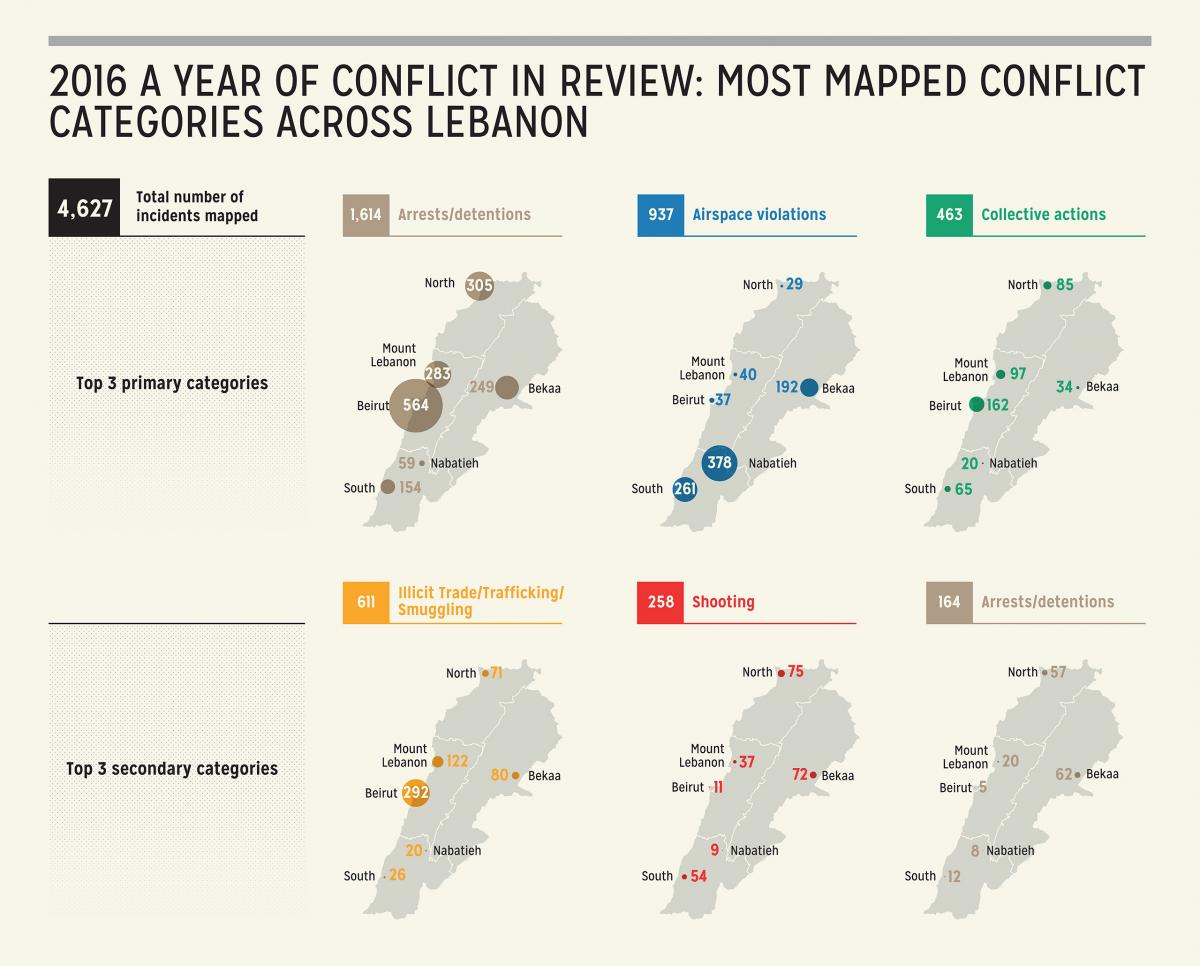
The visual of the Most Mapped Conflict Categories Across Lebanon highlights both the Top 3 primary and Top 3 secondary categories mapped in 2016. All conflict incidents mapped onto our Geolocated Mapping of Conflicts in Lebanon are able to take on a primary and secondary category and classification (read more about our classifications here) depending on the incident’s complexity and depending on Lebanon Support’s methodology of coding.
In total there are 31 socio-political conflict categories in Lebanon Support’s coding system, among these arm storage/smuggling, airstrike, assault, clashes/armed conflict, military/security forces deployment, heavy artillery [including rocket attacks], raid, robbery/trespassing,sea-border crossing/violation, and shooting. When an incident takes on more than one category, it is because more than one type of conflict occurred within the incident. For example, when there is a dispute between individuals that devolves into a shooting, the incident then takes on the primary category of brawl/ dispute and secondary category shooting. In this case, the incident’s categories are determined by chronological order. In other cases, the impact, immensity, and occurrence of a specific category allows that category to outweigh the chronological order of an incident via a weighting system. For example, by rule of the weighting system, a category such as collective action [inc. protests, solidarity movements...] is always a primary category due to the socio-political implications and impact collective actions such as protests, sit-ins, and strikes have on Lebanese society. To be more specific, when there is a protest revolving around the waste management crisis during which security forces are deployed, the incident is coded as collective action [inc. protests, solidarity movements...] for primary category and Military/Security Forces Deployment for the secondary category. Here, the incident’s categories are determined by Lebanon Support’s own weighting system.
In the above visual, of the 4,627 incidents mapped in 2016, almost two thirds of the incidents (3,014 incidents) are primary categorised as either an arrest/detention (1,614), air space violation (937), or collective action [inc. protests, solidarity movements...](463). While the Beirut district exhibits the greatest concentration of arrests and collective actions, it is important to note that conflict incidents are dispersed across Lebanon. Taking into consideration secondary category, there are 148 more illicit trade incidents, often coded with arrest in the primary category, than collective actions.
In 2015, Lebanon Support’s mapping of conflict incidents revealed air space violations (1,162 incidents), arrest/detention (779), collective action [inc. protests, solidarity movements...] (295), shooting (188), raid (168) and heavy artillery (165) as the top 6 mapped primary categories of the year. To summarise, the top 6 primary mapped categories of 2016 were arrest/detention (1,614 incidents), air space violations (937), collective action (463), raid (279), brawl/dispute (247) and heavy artillery (176). This year’s mapping of coded incidents compared to the mapping in 2015 reveals that the category of shooting fell out of the top 6 primary mapped categories and was replaced by brawl/dispute. Comparing the two years, the category of raid has seen the greatest jump in incidents with a 66% increase, while the only category to see a decrease was air space violations, down approximately 19% since last year.
Looking closer into incidents categorised under raid, the 66% increase compared to 2015 in this category does not come as a surprise; in response to the el-Qaa bombings in late June, the state responded by increasing raids across the country targeting terrorist activity (see visual focusing on el-Qaa’s bombings below). The state’s crackdown on Syrian refugees within the country, as well as on Lebanese and other civilians suspected of links to a terrorist organisation led to 42 raids in the month of July and 32 raids in the month of August. Combined, raids mapped in June and July amounted to over a quarter of the total amount of raids recorded in 2016. Of these 74 incidents, 36 were classified in the primary or secondary classification as Border Conflict (Syrian Border), 29 of these also classified as Conflicts of Social Discrimination, which indicates that many of the raids conducted at Syrian refugee encampments are discriminatory in nature. However, it is also important to note that of the 74 raids in June and July, 21 raids were also classified as Power & Governance in the primary or secondary classification. These incidents are often linked to suspected or confirmed terrorist activity. Furthermore, of the 279 raids (primary category) mapped, 218 were carried out by the Lebanese Armed Forces (LAF) (including military intelligence), 51 by the Internal Security Forces (ISF) (also including ISF intelligence), 6 by General Security, 2 by Lebanese Customs, and 2 by State Security.
4. Focus on: A year in review
The following three visuals titled “Most Mapped Actors & Corresponding Types of Conflict,” “Focus on the El Qaa Bombings” and “Focus on Mapped Collective Actions” were featured in Lebanon Support’s three Conflict Analysis Bulletins of 2016 as “Focus on” conflict trends or events. A brief description of each visual is found below and are discussed in greater depth in their respective bulletins.
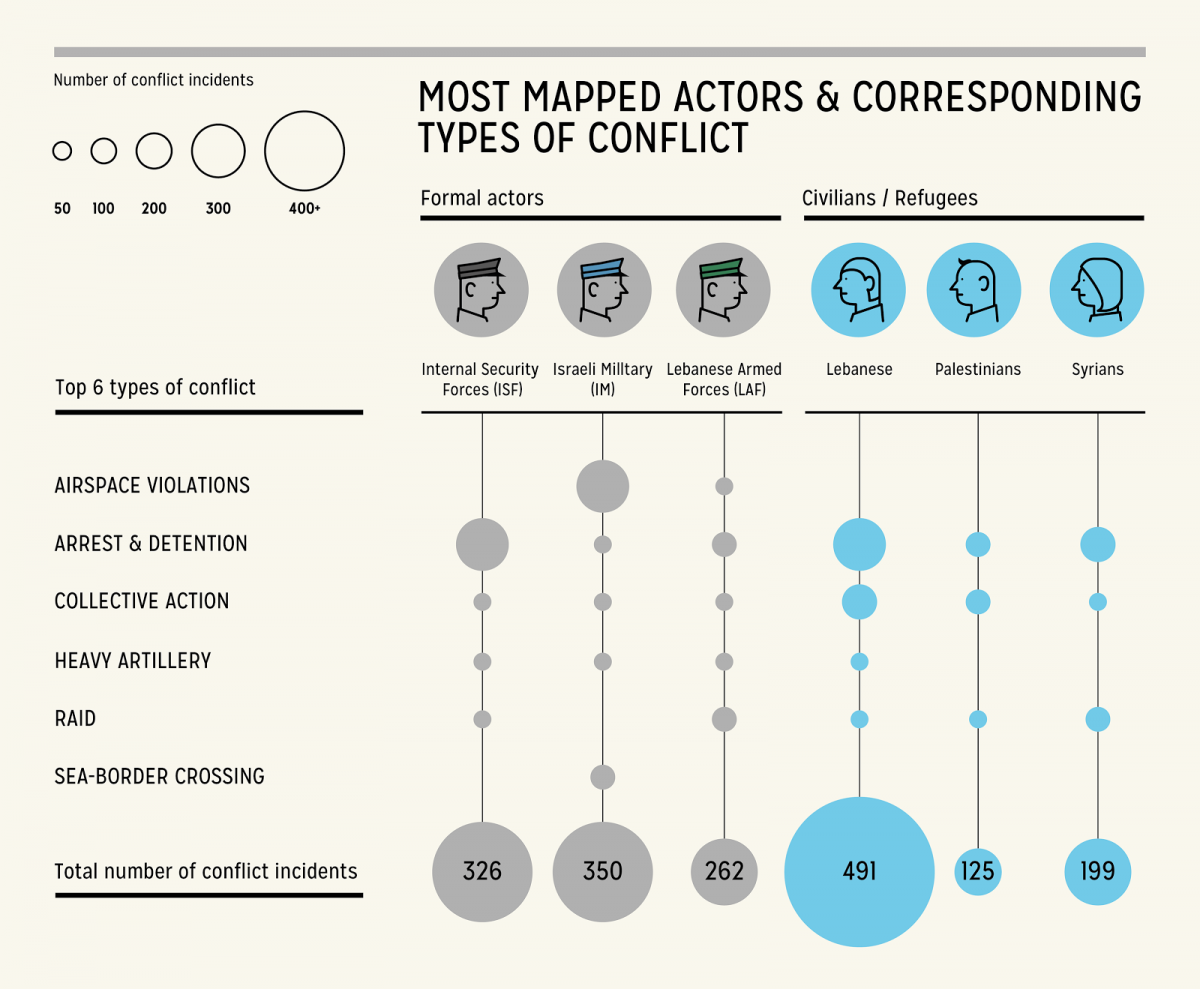
Featured in the third issue of Lebanon Support’s Conflict Analysis Bulletin, the above visual focuses on the top 6 mapped actors in conflict incidents and highlights their involvement in the top 6 corresponding categories of conflict in the months of January- April 2016. Furthermore, the visual highlights the activity levels of both formal actors and civilians/ refugees. Read more on this here.
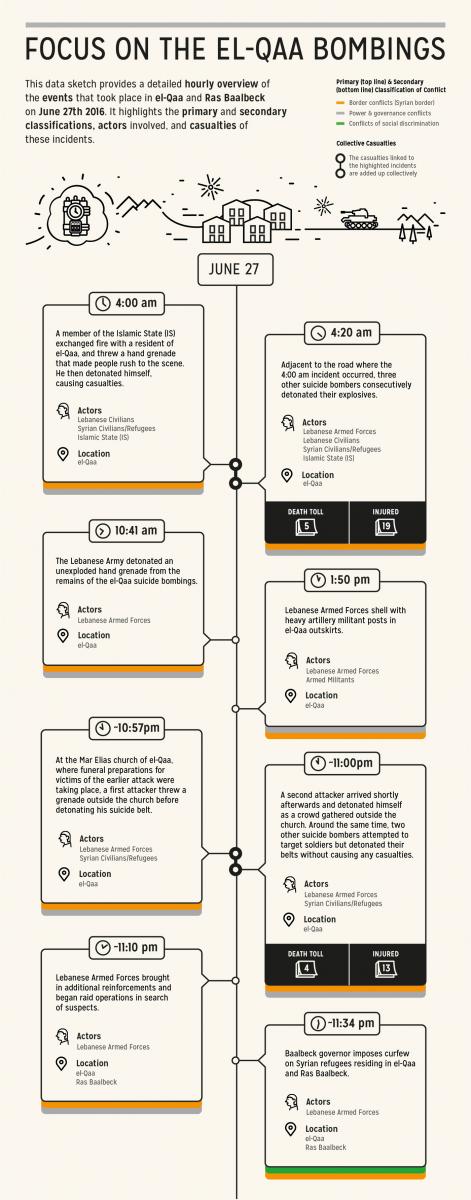
Featured in Lebanon Support’s fourth Conflict Analysis Bulletin, the above visual tracks the happenings of the el-Qaa bombings that took place on June 27th, 2016. The visual also notes the Lebanese state’s response to the bombings through raid operations carried out and curfews imposed on Syrian refugees residing in the el-Qaa and Ras Baalbek area. Read more on this here and to read more on the ongoing Ras Baalbek clashes, see our timeline.
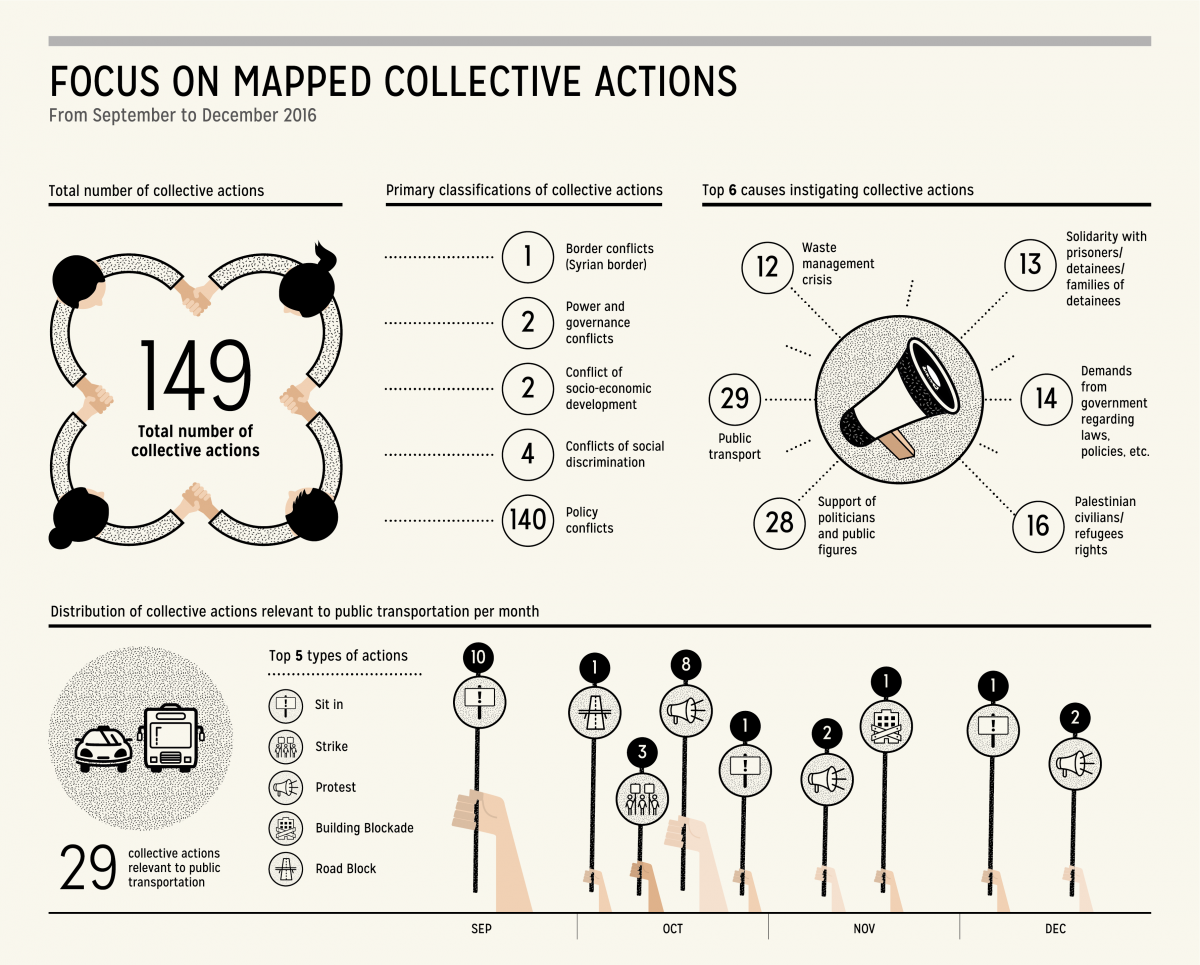
Featured in Lebanon Support’s fifth Conflict Analysis Bulletin published in January 2017, this last focus on visual zoomed in on mapped collective actions in the final third of 2016. The bulletin particularly highlights the top 6 causes that instigated collective actions in September-December. Read more on this here.