Social Policy in Lebanon Between Welfare and Warfare: Civil Society and Expert Engagement and Exchange Towards Social Justice in Lebanon
Panel 3: From Childhood to Old Age: Building a New Social Contract Through Universal Social Protection in Lebanon
Social protection in Lebanon is often framed as a palliative and residual function of the state, an emergency response deployed in moments of acute crisis. This residual approach has left access to protection fragmented and uneven, depending on employment status, occupation, income, family resources, sectarian affiliation, or access to political patronage. The social cost of this public failure is now fully visible: a population in which poverty has become the norm rather than the exception, and in which the social contract, already thin and deeply unequal, has effectively collapsed. Children have borne a disproportionate share of this burden, facing increased risks of poverty, school dropout, poor nutrition, child labour, and long-term exclusion. Such impacts are not only immediate, but risk shaping life trajectories and perpetuating inequalities across generations. Yet, crises are also vectors for opening possibilities. Rebuilding Lebanon's social contract therefore requires placing children and families at the centre of social protection reforms and reimagining social protection not as a residual safety net, but as a universal right and a core function of the state.
In recent years, and particularly in response to overlapping economic, social, and security crises, the very depth of Lebanon's breakdown opened a space for a fundamental rethinking of social protection. Lebanon has witnessed important efforts to strengthen elements of its social protection architecture, marked by the adoption of the long-awaited National Social Protection Strategy in 2024. A few months earlier, in December 2023, Law 319 established a pension scheme for private sector workers, as well as restructured the National Social Security Fund (NSSF) Board of Directors; two long-awaited social policy reforms. In addition, programs such as the National Poverty Targeting Program and AMAN, alongside the introduction of Lebanon's first social grant, the national disability allowance (NDA), reflected a growing recognition of the need for more institutionalised forms of social assistance. These initiatives are particularly important in a context where repeated crises and conflict have undermined the wellbeing of children and families, highlighting the need for a comprehensive system that protects people throughout the life cycle and prevents temporary shocks from becoming permanent disadvantages. However, implementation efforts remain slow, partial, and fragmented.
The extent of the impact of the crises and repeated wars urges us to rethink social protection as not merely emergency relief or targeted assistance, but as a social right and a core function of the state, capable of ensuring universal and equitable protection across the life cycle. In this sense, universal social protection should be repositioned as a foundational pillar capable of protecting children from the long-term consequences of poverty and displacement, supporting families through periods of crisis, and strengthening social cohesion across generations. As such, it should form the cornerstone of any renewed social contract and of any credible vision for social and economic recovery.
The previous session in this series argued that the Lebanese social contract is broken from two sides: a regressive and insufficient revenue system and a fragmented social protection system that leaves many needs unmet. This discussion furthers that argument by exploring the principle of reciprocity that lies at the heart of any social contract. Contributions generate entitlements, and this should guarantee protection against life’s major social risks. Universal social protection gives concrete expression to that principle by extending protection as a right rather than a privilege tied to employment, income, or political affiliation. Participants are thus invited to move beyond programme design and financing mechanics, important as these are, and engage with the deeper question: what kind of social contract do we want to build? How can universal social protection serve as its most concrete and tangible expression, and contribute to reducing child poverty, supporting children's recovery from conflict and crisis, and breaking the intergenerational transmission of poverty? Can a society marked by widespread informality, recurring crises, repeated displacement, war, fragmented welfare arrangements, and deep inequalities continue to rely on targeted and residual forms of assistance, or does it require a universal approach to social protection capable of guaranteeing a basic level of security and dignity for everyone? In other words, what would it take to guarantee every child in Lebanon a minimum level of protection, opportunity, and dignity?
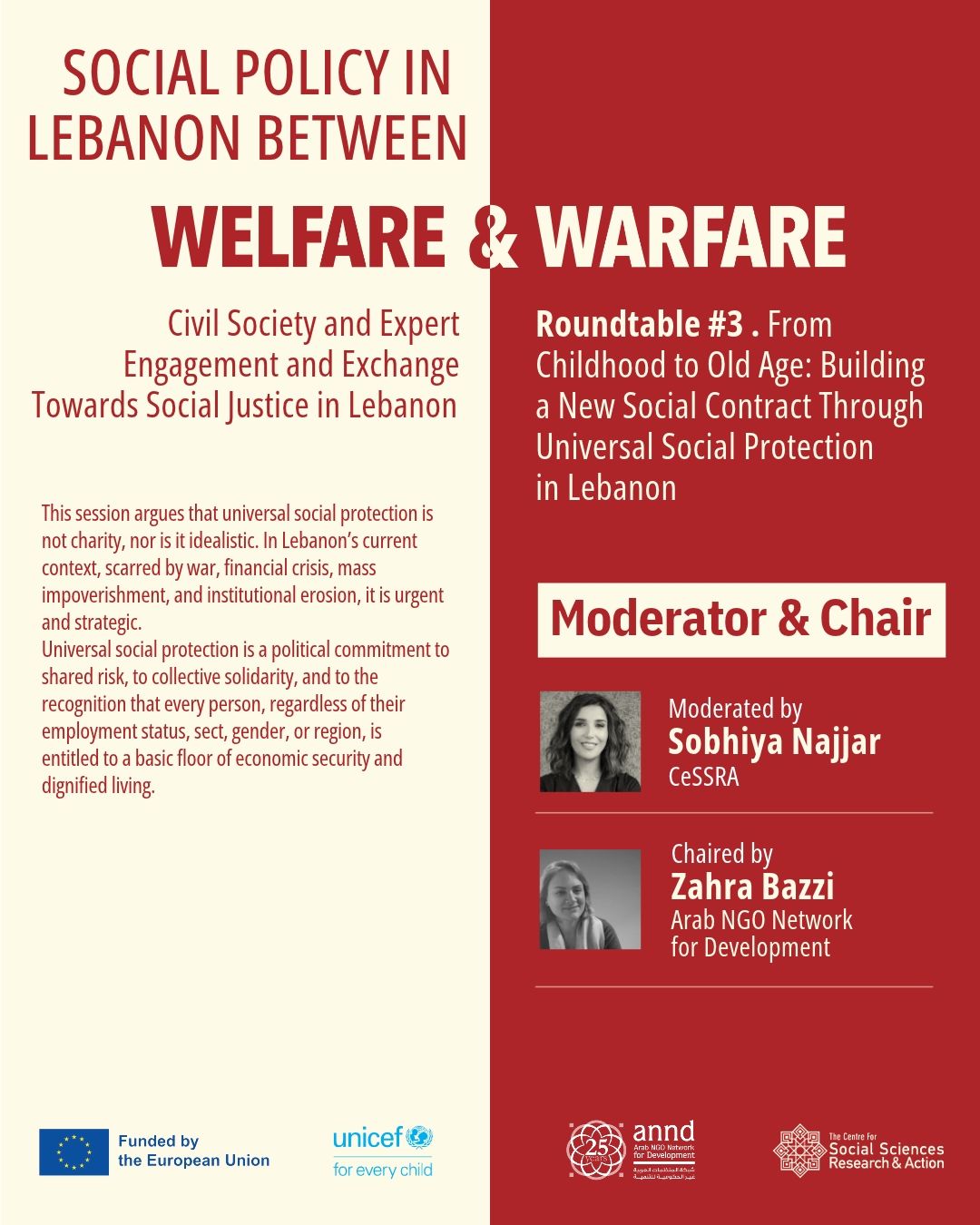
This session argues that universal social protection is not charity, nor is it idealistic. In Lebanon’s current context, scarred by war, financial crisis, mass impoverishment, and institutional erosion, it is urgent and strategic. A coherent, rights-based, adaptive, and adequately financed social protection system is among the most powerful tools available for stabilising households, rebuilding trust in public institutions, and laying the groundwork for an inclusive recovery. Universal social protection is a political commitment to shared risk, to collective solidarity, and to the recognition that every person, regardless of their employment status, sect, gender, or region, is entitled to a basic floor of economic security and dignified living. In practice, this means ensuring that every child has access to a minimum level of income security, essential services, and opportunities to thrive, regardless of where they are born or their family's circumstances. It is, in short, an expression of citizenship.
This event is co-hosted by the Centre for Social Sciences Research and Action (CeSSRA) and the Arab NGO Network for Development (ANND).
This event is part of the series “Social Policy in Lebanon Between Welfare and Warfare: Multistakeholder Engagement and Exchange Towards Universality”, a project implemented in partnership with UNICEF and funded by the European Union.
Date: 17 November 2026.
Duration: from 10am to 1pm
Location: Smallville Hotel
Kindly RSVP physical attendance by email to contact@socialsciences-centre.org.
Hybrid modality: please register on this link via Zoom:
https://us06web.zoom.us/webinar/register/WN_joH-AJuCSyiOAc4QGceXwA
Agenda
10:00 - 10: 10 | Welcome and Registration
10:10 - 10:40 | Universal Social Protection versus Targeted Approaches
The introduction will address the limits of the targeted and residual forms of assistance, and make the case for a universal approach to social protection, in order to treat social protection as a right and a pillar of the social contract.
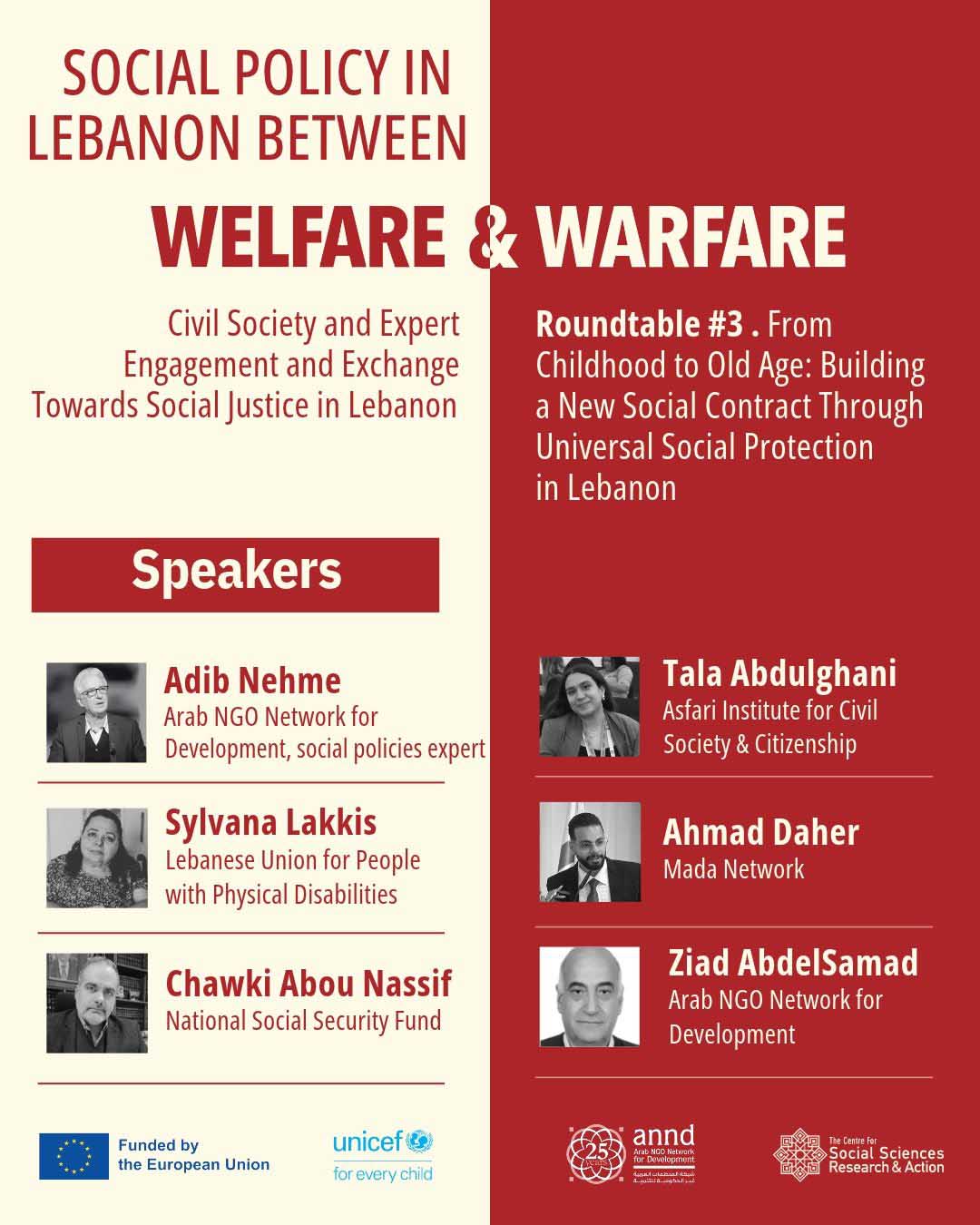
Speaker: Adib Nehme, consultant and expert on development and socio-economic policies and poverty, consultant for the Arab NGO Network for Development, and a freelance consultant on development issues.
10:40 - 12:15 | The Current State of Social Protection in Lebanon
This session brings together speakers who address the current state of social protection in Lebanon from their own lived experiences and professional backgrounds, focusing on 4 aspects: 1) the National Social Security Fund legal framework and future, 2) the National Disability Allowance as a step toward universality 3) unpaid care work and women’s access to social protection, and 4) youth perspectives on social protection coverage. The floor will then be opened for discussion.
Speakers:
- Chawki Abou Nassif, Financial Director, National Social Security Fund
- Sylvana Lakkis, president, Lebanese Union for People with Physical Disabilities (LUPD)
- Tala Abdul Ghani, Senior researcher, Asfari Institute for Civil Society and Citizenship
- Ahmad Daher, Mada Network
Chair:
Zahra Bazzi, Programs Director, Arab NGO Network for Development
12:15 - 13:00 | Recommendation, conclusion, and Q&A
Concluding remarks draws together recommendations on social policies, national ownership and governance.
Speaker: Ziad Abdel Samad, Executive Director, Arab NGO Network for Development
Moderator: Sobhiya Najjar, CeSSRA