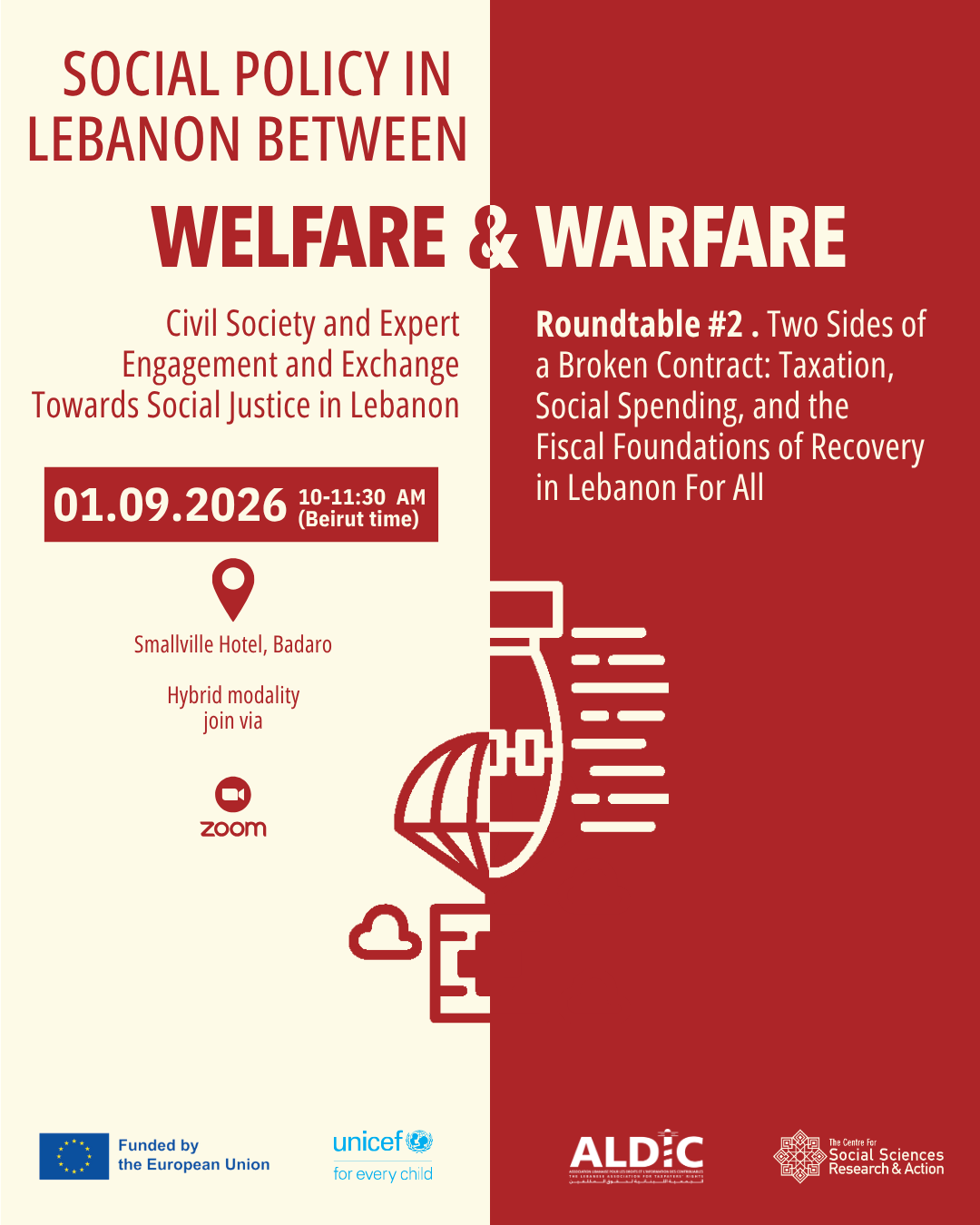
Social Policy in Lebanon between Welfare and Warfare: Civil Society and Expert Engagement and Exchange towards Social Justice in Lebanon
Roundtable 2: Two Sides of a Broken Contract: Taxation, Social Spending, and the Fiscal Foundations of Recovery in Lebanon For All
Lebanon’s path to recovery runs through its fiscal system. How the state raises resources, how it allocates them, and who bears the costs and receives the benefits of those choices are not peripheral questions; they are the very substance of the social contract. In a country where that contract has effectively collapsed, rebuilding it requires more than political goodwill or technical reform. It demands a fundamental rethinking of the relationship between taxation, public spending, and the collective obligations of the state toward its citizens, notably the most vulnerable, including poorer households, women, persons with disabilities, the elderly, and children. This session sits at the heart of that rethinking, contributing to a broader conversation on what financing recovery in Lebanon must look like if it is to be equitable, sustainable, and transformative.
Both sides of Lebanon’s fiscal contract are deeply broken. The country extracts too little from too narrow a base, and in structurally regressive ways, while its social spending remains fragmented, underfunded, and chronically misaligned with the scale of its population’s and households’ needs. Questions of public budgeting and revenue mobilisation are no longer merely technical, they are deeply political, and their answers will shape the next generation, and the kind of society Lebanon rebuilds, or fails to rebuild, in the years ahead.
The revenue crisis and the spending crisis are inseparable. Lebanon’s fiscal architecture remains heavily reliant on indirect taxation (VAT, fuel excises, customs duties) instruments that are, by design, blind to income and wealth. In practice, this means that ordinary families pay a larger share of their income just to afford food, transport, electricity, and basic necessities, while wealth, large property holdings, and financial profits remain lightly taxed or protected. In times of wars and crises, the consequences are felt directly in people’s daily lives. Families are forced to cut spending on healthcare, education, nutrition, and transportation. Children are among the most affected. When households lose income and public services collapse, children face higher risks of poverty, malnutrition, school dropout, child labour, and long-term exclusion. Understanding Lebanon’s tax system requires examining not only what is taxed but what remains largely untaxed. Who really pays for the crisis and the recovery in Lebanon’s current tax system, and how does this affect people’s everyday lives?
This session interrogates both sides of Lebanon’s fiscal contract through the lens of justice, equity, and long-term resilience. It will explore how fiscal reforms can help protect households from shocks, reduce poverty, and create the conditions for a fair recovery for all, including the most vulnerable.
On the revenue side, it asks not only what Lebanon taxes, but what it refuses to tax, and why. It examines the distributional consequences of the current fiscal mix, the structural barriers to progressive reform, and the political coalitions that must shift if Lebanon is to build a tax system capable of financing universal social protection.
On the spending side, it asks how social budgets can be restructured to move beyond fragmented, crisis-driven transfers toward a coherent, rights-based, and shock-responsive system that genuinely protects the most vulnerable and leaves no one behind.
It also aims to answer harder questions: Who bears the cost of crises? Whose vulnerabilities are rendered invisible in budgetary choices? What would it take to build a social protection system that is not merely reactive to shocks, but structurally designed to absorb and adapt to them? And how do fiscal choices shape the opportunities and well-being of Lebanon’s youngest populations?
This round table seeks to bridge the gap between technical budget and tax analysis and transformative policy reform, with a clear horizon: a universal, resilient, and adaptive-by-design rights-based social protection system for Lebanon that leaves no one behind.
This webinar is co-hosted by the Centre for Social Sciences Research & Action (CeSSRA) and ALDIC, The Lebanese Association for Taxpayers’ Rights.
Chair: Sabine Hatem (Chief Economist and Director of Cooperation and Partnerships, Institut des Finances Basil Fuleihan)
Speakers:
Dr Sami Atallah (Director, The Policy Initiative)
Me Ralph El Najjar (Lawyer and tax associate, Watson Farley & Williams. Executive board member of ALDIC, The Lebanese Association for Taxpayers’ Rights)
Date: 1 September 2026
Time: 10:00 am to 11:30 am
Location: Smallville Hotel, Badaro
Kindly RSVP physical attendance by email to contact@socialsciences-centre.org.
Hybrid modality: please register on this link via Zoom https://us06web.zoom.us/webinar/register/WN_TqOyEUacRBWWDOasUZ196w